

Instagram
Facebook
YouTube
Contact
Neue Notenrollen

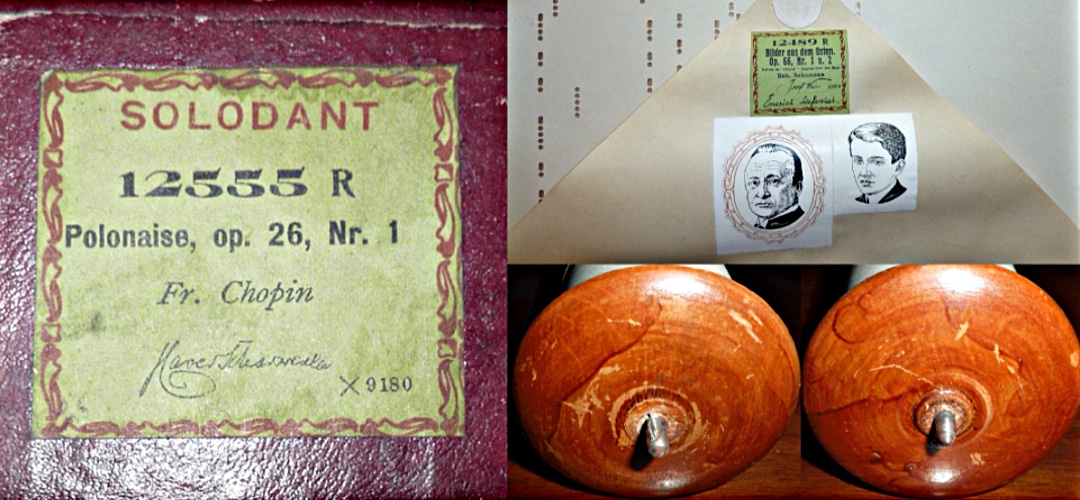
How does a Hupfeld 72 note Phonola roll look like?

In Germany, Hupfeld was the largest supplier of artist's music rolls for its own Hupfeld phonola art instruments. The phonola music rolls with the 72/73 scale were sold from 1902 initially only as drawn and then from 1905 also as hand-recorded artist rolls and only work on Hupfeld instruments. The paper is 29.5 cm wide.

The drawn Phonola rolls have numbers below 12000, while hand-recorded artist rolls have roll numbers from 12000, often with the signature and sometimes a photo of the recording artist. The paper has the watermark "Phonola" and the date of manufacture at the beginning on the reverse. The Hupfeld Phonola rolls have wooden flanks and metal spikes on both sides for mounting in the music roll case. As these rolls are hooked into the lower spool and run upwards, the roll label is arranged accordingly.

72 standard music rolls were also occasionally offered under licence by other manufacturers. For example, these rolls can also be found from SM (Schüller and Meissner).

Möchten Sie uns unterstützen?

Liebe FASZINATIONPIANOLA – Besucher ❣️

We love Pianos / Pianolas and offer a lot of extraordinary things on these pages. This involves a lot of time and expenses for us.

We welcome feedback and appreciative support so that we can continue to provide special finds from our worldwide research.


For voluntary contributions at paypal.me/faszinationpianola we are very grateful 🤗 in the context of §60 c UrhG, expressly without profit-making intention.

This is a PayPal.Me link, you can find out more about it here:

What is PayPal.Me? | PayPal DE

PayPal.Me | Pay thru link | PayPal DE

New: The Piano Book

"Anyone who loves the piano will love these stories."
(Michael Ashton, Korrepetitor, Musikarrangeur, Hamburg)

“Marc’s extraordinary passion and his deep knowledge of the history of pianos, pianolas, and piano rolls come alive in this book.”
(Dr. Peter Phillips, PhD Musicology, Sydney University)

12 stories—all inspired by true events,
88 practical answers to fascinating questions about the piano.
2 checklists: ‘What Is My Piano Worth?’ and ‘What to Do If Your Piano Has Ivory Keys.

More than 400 pages filled with a fascination for pianos—and, above all, for the people whose lives and stories are intertwined with these instruments in so many different ways.