



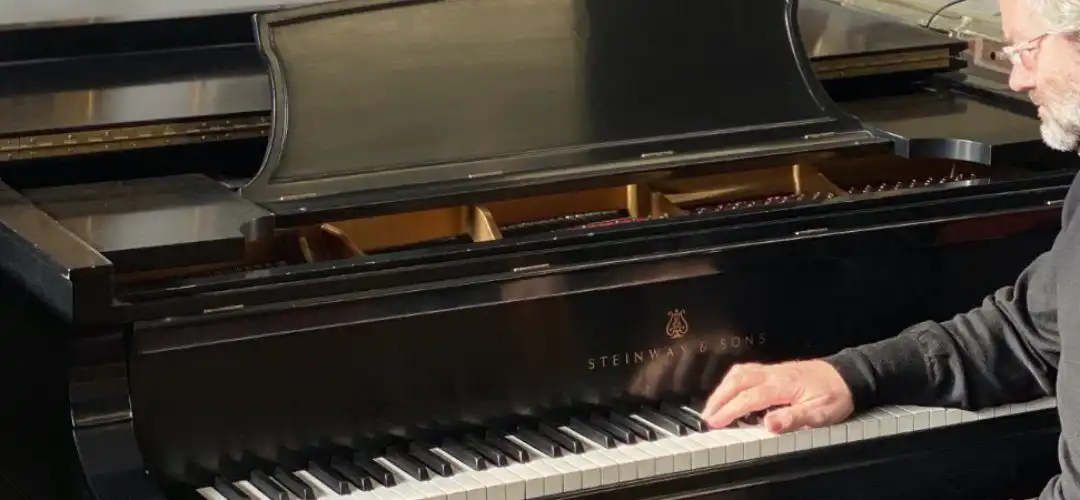
The beautiful quote by Franz Liszt, “My piano is to me what his frigate is to the sailor, his horse to the Arab – more still: my language, my life!”, from one of his travel letters at the end of the 1830s, shows the potentially high emotional value of a piano. The same can apply to beloved family instruments or pianos that have grown dear to one’s heart for other reasons.
In our view, a piano has several values,
- the emotional value
- the musical value
- the historical value
- the economic value
- the ecological value
The musical value
We see the musical value in the beauty of an instrument’s sound – this can certainly be unique, both in new instruments and in aged instruments that have developed a unique character.
The historical value
The historical value relates to aspects of instrument making, the history of piano making and the owners. Old pianos in particular are often testimonies to their type of construction and therefore only exist in limited numbers. If instruments belonged to important personalities, this is also historically interesting. However, museums and collections are overflowing with such instruments, and only very few instruments in private ownership fall into this category.
The economic value
For the economic value, the Association of German Piano Makers (BDK), together with other experts, has compiled a valuation table on the depreciation of pianos – similar to the Schwacke list (Germany’s equivalent of Kelley Blue Book) in the car trade.
Differentiated by piano quality in classes from “lowest” to “highest” – where “highest” presumably includes brands such as Steinway & Sons, etc. – it states that pianos lose their economic value completely after a number of years, i.e.,
- a piano of the lowest class after 15 years
- a piano of the middle class after 35 years
- a piano of the highest class after 70 years
Of course, these are only guide values, since condition, model and market have an influence here. A Steinway piano of any model from 1950 – i.e. seventy years old in 2020 according to the list – certainly does not have a value of 0, but still a four- to five-figure euro amount.
The stated loss of value on new pianos is between 30 and 40% for all quality classes! As with cars, the buyer of a new piano therefore “loses” about a third of the purchase price in the first year.
Even after the periods in the table above, a brand-name piano usually still has a stable residual value. Depending on supply and demand, however, this can no longer be realized. In our understanding, it therefore still has its value.
If only the currently achievable sale price is regarded as the value, the European and American piano markets are currently developing in a very unfavorable direction in terms of the value of older pianos. The simple reason: demand has been falling dramatically for years – while millions of used pianos are on the market. Only in markets where demand is still rising or can rise, currently in Asia and Africa, does this look different.
From our observation, even German brand-name pianos can hardly be sold in Europe anymore – there is hardly any private demand left – and so piano dealers are no longer interested in more instruments either – their warehouses are usually overflowing. This development will continue. Free giveaway ads, even for premium brands such as Ibach, Feurich and Blüthner, are increasing significantly. The rules for pianos with ivory on the keys, in force since January 19, 2022, make things even more difficult. For details, see our article “Ivory keys on pianos”. In extreme cases, this makes a piano unsellable, or greatly reduces its value and demand.
Apart from unique pieces and special rarities, a piano is not an investment in the sense of a predictable increase in value. From this point of view, a piano is only worthwhile as an investment if it is not a new piano – and preferably a Steinway piano. Brands such as Blüthner, Bechstein and now also Yamaha can be a sensible investment if the purchase price was reasonable – and the instrument is well maintained.
For owners of a used piano, the question “What is my piano still worth?” is therefore answered quite simply – exactly as much as it still fetches in an ad after a reasonable time. Dealers and collectors watch private and commercial ads practically daily – so their demand also clearly shows the current market value.
If you would like a specific appraisal of your piano, we offer an assessment and appraisal of your instrument as a paid service. You can find details of our offer here.
The ecological value
The ecological value of a piano has so far been little researched scientifically or discussed publicly. Nevertheless, a piano contains many hundreds of working hours and hundreds of kilograms of raw materials, produced with considerable use of energy and resources. Please also read our blog post “How do I dispose of a piano?”.
For us, appreciating this ecological value means striving for a sensible and the best possible ecological balance in production, maintenance and final recycling. As with almost everything, buying and maintaining a used piano is therefore ecologically much better than producing a new piano, since no new raw materials and energy are consumed. Even the careful renovation of an old piano means a much lower use of resources than building a new one. Please also read about our piano disposal service.
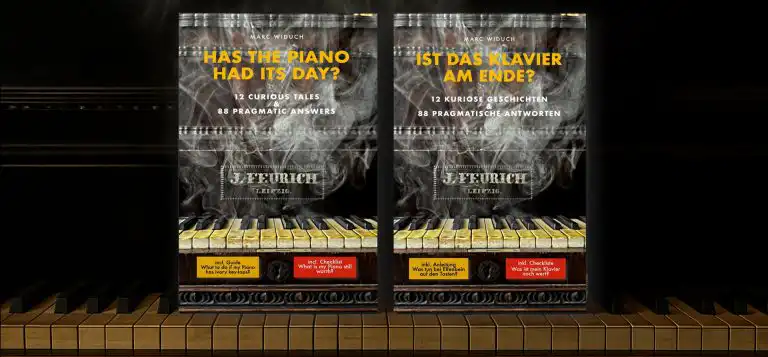
The Piano Book: “Has the Piano Had Its Day?”
12 curious tales and 88 pragmatic answers about the piano, plus the checklists “What is my piano still worth?” and “What to do if there is ivory on the keys?” and personal information about your own instrument. Signed on request – a lovely gift, too. More about the book
Related: How to date a piano · Piano appraisal · Piano purchase · Pianos for sale