

Instagram
Facebook
YouTube
Contact
New Music Rolls

Piano Dating…

We have serial number information for most piano manufacturers, or we can determine the age of the piano and many other details. This also applies to instruments by Welte, Hupfeld, etc.
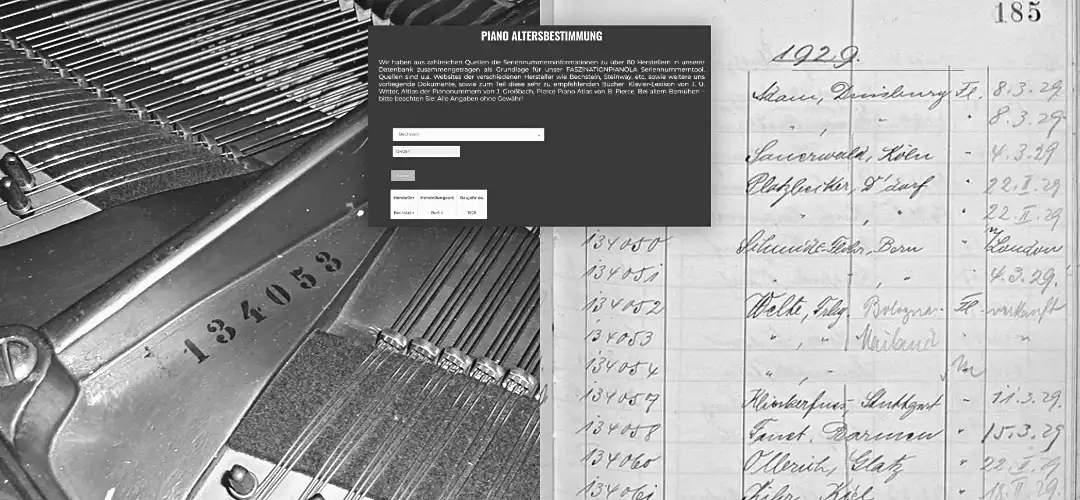
HOW OLD IS MY PIANO?

Almost all piano manufacturers gave their instruments serial numbers, usually stamped into the wood in the upper interior or painted onto the cast-iron frame. These numbers can be used to determine the approximate year of manufacture, provided the relevant records have survived. Unfortunately, this is not the case for all manufacturers, especially lesser-known ones, and also, for example, for built-in player pianos, where often only experts can tell which piano was used. In addition, clear serial numbers are occasionally missing because they were lost during production or later renovations.

The certificate required since January 19, 2022 for all pianos with ivory key coverings requires verifiable dating. If it is not possible to obtain a so-called manufacturer’s certificate from piano manufacturers that still exist, most authorities accept expert information from a recognized expert – which we can provide for a fee. In some cases, however, only a report by a listed expert is accepted.

If you would only like to know the age of your piano, we offer simple information by email on request, providing only the stated year of manufacture based on the sources available to us. Please send us a message stating the manufacturer and the serial number.

If you need a more detailed certificate, or if no year of manufacture for your piano can be found in the literature, we offer information for a fee – then also together with further information about the manufacturer and the instrument, if available to us.

HOW CAN I FIND OUT WHAT MY PIANO IS WORTH?

Please also read our blog post “What is my piano still worth?”. If you would like a statement on the value of your piano, we offer a remote assessment for a fee based on the information and photos you provide – on request and for a surcharge, we can also send a master piano maker to take a closer look at the instrument on site. You can also ask any local piano maker for an on-site inspection and assessment of the piano.

WHERE DO I FIND THE SERIAL NUMBER ON PIANOS?

As a rule, the serial number is easy to find without major disassembly of the piano. First lift the top lid of the piano; the serial number is usually on the cast-iron plate, on the inside of the case on the right or left, sometimes stamped on the upper edges, or on the soundboard under the strings. Sometimes – especially if the instrument was not renovated properly – the serial number has been removed and can only be found in well-hidden places (on the keyframe, on individual parts of the piano, etc.). The production period can also be determined from the serial number of the action by well-known manufacturers such as Renner or Schwander.

You can open the upper front panel by lifting the top lid and then releasing the catches on the inside, on the right and on the left, simply by turning the small wooden latches fitted there. You can then lift the upper front panel off toward you. If candlesticks are fitted, make sure they do not knock against the panel and cause scratches when you remove it and set it down.

You can remove the lower panel either by bending the small wooden latch in the middle upward – or by turning the rotating latches on the right and left so that the panel can be lifted freely toward you. When transporting upright pianos, it is better to remove this lower panel or secure it well, as it otherwise tends to fall off when jolted and gets scratched.

WHERE DO I FIND THE SERIAL NUMBER ON PIANOLAS?

For pianolas, too, the most reliable way to determine the age is the piano’s serial number. In addition, the player mechanism carries further serial numbers from the manufacturers of these components. Dating based on these is also possible, but less precise, since we have no information from the manufacturers and work with our own records. In the following photos you will find examples of the position and appearance of serial numbers on pianolas from various manufacturers.

You can open the upper front panel by lifting the top lid and then releasing the catches on the inside, on the right and on the left, simply by turning the small wooden latches fitted there. You can then lift the upper front panel off toward you. If candlesticks are fitted, make sure they do not knock against the panel and cause scratches when you remove it and set it down.

You can remove the lower panel either by bending the small wooden latch in the middle upward – or by turning the rotating latches on the right and left so that the panel can be lifted freely toward you. When transporting upright pianos, it is better to remove this lower panel or secure it well, as it otherwise tends to fall off when jolted and gets scratched.

On Welte-Mignon push-up players (Vorsetzer) there are two serial numbers – one at the top right in front of the wind motor, stamped into the wood.

…and one serial number on the back, usually stamped into the wood at the top right.

Welte-Mignon cabinets also have two serial numbers, one on the back of the case, usually at the top right…

…and the piano serial number hidden in the interior on the left below the action on the soundboard (on Feurich pianos).

On Welte grand pianos there is usually another serial number below the spool box on the right…

On Welte upright and grand pianos there is a serial number on the wind chest (e.g. FEU for Feurich, ST for Steinway, etc.) and a number…

On Hupfeld instruments, there are two serial numbers on a metal plaque – a piano no. and a player unit no.

On Hupfeld Phonola built-in players, the Hupfeld serial number can also be found on the upper unit, usually on the edge near the wind motor…

On Hupfeld DEA push-up players there is a serial number in the lower interior on the wind chest.

On Hupfeld Phonola push-up players, the serial number is on the edge of the pedal rod bracket at the back of the push-up player.
The piano book “Has the Piano Had Its Day?” by Marc Widuch

The Piano Book: “Has the Piano Had Its Day?”
12 curious tales and 88 pragmatic answers about the piano, plus the checklists “What is my piano still worth?” and “What to do if there is ivory on the keys?” and personal information about your own instrument. Signed on request – a lovely gift, too. More about the book