



First of all – the following statements do not replace legal advice and make no claim to correctness or completeness; any liability is excluded. In a specific case, please contact the authority responsible for you or a legal adviser of your choice. The following statements are only intended to raise awareness of the relevance of this topic in connection with used pianos. Details can be found here on the website of the German Federal Agency for Nature Conservation (BfN) and here on the website of the European Commission.
What has changed?
With effect from January 19, 2022, the EU has in principle suspended trade in ivory and ivory products, including items containing worked ivory (and therefore piano key coverings), allowing it only under strict rules in certain exceptional cases. The purpose is to prohibit trade in ivory and/or make it unprofitable. In principle, this also affects all pianos whose white keys are covered with ivory. Before January 19, 2022, trade was already restricted, so that a CITES document from the BfN was required for every border crossing into or out of the EU. Pianos with ivory on the keys built from 1975 onward may no longer be traded at all. Incidentally, even before January 19, 2022, intra-European trade in musical instruments containing ivory without a certificate was only permitted if the ivory demonstrably dated from before 1947 and had not been altered after 1947. A certificate cannot be applied for retroactively. EC certificates issued before January 19, 2022 lost their validity on January 19, 2023. With the tightening from January 19, 2022, an exemption permit must now be obtained from the competent authority for EVERY purchase / sale, also within the EU and also within each country. Without such a certificate, trading is a punishable offense!
May I sell a piano with ivory keys on eBay?
No. Not for a long time now. Our most recent inquiry to eBay Kleinanzeigen (January 2023) again produced: “Our policies on prohibited items state: trading in ivory and all ivory products, regardless of the origin of the ivory or ivory product, including prehistoric ivory. This ban has applied on eBay Kleinanzeigen for more than 10 years. Therefore, pianos that have a marketing certificate may not be offered on our platform either.” This means that pianos with ivory key coverings may no longer be offered on eBay at all – with or without a certificate. This usually applies to other platforms as well. Nevertheless, a great many new listings that contravene this ban appear every day. Since the tightening of the EU rules, checks are also increasing, so it can be assumed that this punishable act will be sanctioned more frequently in the future.
Does this apply to every piano with ivory?
Yes. Pianos with ivory built from 1975 onward may no longer be traded at all. Pianos from before 1975 can be offered with a marketing certificate. And – this tightening of the law affects not only commercial trade, but every purchase and sale, i.e. every change of ownership of a piano with ivory on the keys. This of course also applies to individual keys or entire keyboards if they are offered separately. Pianos from before 1947 are considered antiques and now also require such a permit in principle. A permit is only granted if the piano is not used exclusively as an exhibition object – i.e. if it is or can be used as a musical instrument.

Image: FASZINATIONPIANOLA
Is this a matter for the buyer or the seller?
In principle, every seller is obliged to have the appropriate permit before offering such an instrument. But all buyers are also obliged to check before buying whether the seller has such a certificate for the instrument. If not, buying without a certificate is also punishable. If pianos with ivory key coverings are part of a business, certificates are required in principle.
May I still own a piano with ivory key coverings?
If the instrument is and remains in the same private ownership, in principle no EU certificate is needed – this also includes inheritance and moves in which a piano is part of private household goods. However, if several instruments are in private ownership, the question arises whether this still counts as “normal household goods” and whether non-commercial interests really clearly predominate. A matter of interpretation! If in doubt, it is certainly better to clarify the case with the local authorities. If an EU certificate can be obtained for the instrument, it may make sense to have one issued as a precaution, to be prepared for future eventualities.
Is it possible to give away a piano with ivory?
“Trade” of course means any change of ownership in return for consideration (money or exchange in kind) – i.e. also all purchases and sales between private individuals. In the definitions of the relevant regulation, however, “trade” also includes: import, export, re-export, use, transport or transfer – which covers pretty much everything, possibly including transfer free of charge, i.e. a gift, which would not normally be understood as trade. Whether a gift is possible or not must be clarified in advance with the locally competent authority. Any commercial work on an affected piano by third parties, i.e. repair, transport, storage, etc., without an EU certificate is at least a legal gray area. In the definitions of the relevant regulation, “sale” is equated with: any form of sale, renting, barter or exchange – and related expressions are to be interpreted accordingly. These definitions make clear how broadly the rules can be interpreted. It is advisable to clarify the specific case with the competent authority well in advance. Even museums and collections are subject to these strict rules and should clarify the respective situation with the competent authority.
Remove the key coverings?
It does in fact seem to be permitted, and possible without a certificate, to buy or sell a piano without the keys or without the ivory key coverings, provided this is correctly set out in the contract and realistically reflected in the price. However, most pianos without keys will lose almost all of their value, since making new ones involves considerable costs in the four-figure range. It is possible to remove the existing ivory and sell the piano with keys but without ivory key coverings. However, this should be done by a specialist company, as the risk of damaging the keys is high. Quite apart from the questionable sense of removing the covering, the legal rules on handling and possibly disposing of the ivory must also be observed here. So it is better to obtain a certificate first and then preserve the instrument with its original coverings.
Validity of the permit?
If a marketing permit has been granted that stays with the instrument, it can also be resold with this document – the certificates can be issued without an expiry date. Only if changes are made to the ivory must a new permit be obtained.
How much ivory is in a piano?
The vast majority of pianos from before 1947 have ivory as the covering for the white keys. Some, however, have a covering of bone or plastic (see also our article “What condition is the piano keyboard in?”) – this is not always easy to tell apart. The key coverings were glued onto the wooden key with bone glue, usually divided into a front piece, a back piece and a fronts piece – recognizable by the dust deposits at the cut edges. Sometimes the small fronts are not ivory but plastic. Depending on the key size, number of keys, type of covering and thickness of the ivory, this concerns about 50 keys with about 4–6 g of covering each, i.e. about 200–300 g in total.

Image: FASZINATIONPIANOLA
Where do I get such a permit?
The certificates are issued by the competent state authorities, usually the responsible district office (Landratsamt). The costs of such an application vary from state to state. Detailed information about the instrument is required for the application in order to prove the type, year of manufacture, condition and above all details of the ivory present. Some piano manufacturers that still exist today issue so-called manufacturer’s certificates on request. Sometimes an independent expert opinion is also required to confirm that the ivory has been unchanged since 1975. In the absence of original manufacturer documents for old pianos, this requires expert knowledge and access to specialist documents.
What about private ads?
The new law applies to every purchase and sale, i.e. also to every ad on classifieds marketplaces, in newspapers or on the internet – whether private or commercial. That is why the big platforms also prohibit ads on the internet that mention “ivory” key coverings. Omitting this term usually makes it possible to post the ad – but in our view the person posting it is still acting unlawfully. So be careful.
Does this make sense for old pianos?
The question no longer really arises, since it is now the law. The tightening of the rules became necessary because all previous measures had not slowed down the illegal ivory trade – on the contrary, it has reached a record level. According to the BfN, an estimated 20,000 to 30,000 African elephants are poached every year. Elephant populations are also threatened by the increasing involvement of global criminal trading networks. In drafting the rules, the EU involved experts and representatives of associations – including from the musical instrument and antiques sectors – which made the strict exemptions for musical instruments possible. It is right to do everything possible to prevent illegal trade in ivory. Even if none of it probably ends up on piano keys today – and old ivory coverings on piano keys will not save the life of a single elephant – the aim is to stop trade in ivory and ivory products completely and thus put an end to this cruel business.
Does this also apply to disposal?
Even before, it was wrong simply to dispose of pianos, since they are then usually just incinerated completely and produce harmful slag – see also our article “How do I dispose of my piano?”. In our view, the new law allows handing over to a disposal company, provided no payment for the piano in the sense of trade is involved. In any case, it is better to have the piano recycled properly, so that any ivory is also preserved, documented, for repairing other old pianos wherever possible.
Why ivory in the first place?
For many who deal with old pianos, ivory key coverings are quite normal – even a welcome detail in terms of authenticity, value retention and restorability. The history of the use of ivory in piano making could fill an article of its own, so here are just a few remarks for historical context. Bone and ivory were used early on as a beautiful and, above all, very durable material, including for key coverings in instrument making.
In the heyday of piano making, 1850–1920, huge quantities of ivory were needed. At the beginning of the 20th century, the trade media were already reporting a lot about the shortage of ivory supplies, because the extermination of the elephants made the raw material so rare and expensive. Nevertheless, 70,000–100,000 elephants a year were still killed, mainly in Africa, for their ivory. In the decades before, there were probably considerably more. Carved art objects, billiard balls and piano key coverings were the main products. In 1913, 75% of the approx. 140,000 pianos made in Germany alone were still fitted with ivory key coverings; in 1929 it was still 35% of the only approx. 65,000 pianos produced. Ethical concerns played hardly any role in this development – the decline in the use of ivory was brought about solely by economic factors and soon also by regulatory restrictions.
The first substitute products with fanciful names such as “Elfenit” could not match the durability and feel of ivory, despite advertising claims to the contrary. Until the early 1980s, pianos with ivory key coverings were still occasionally offered from so-called remaining stocks of piano manufacturers. Today, ivory no longer plays any role as a key covering in new piano making, since plastic substitutes have equal or superior visual and tactile properties – and above all are considerably cheaper.

Image: “Der Pianofortebau – Theorie und Praxis des Baues der Flügel und Pianinos” (piano making – theory and practice of building grand and upright pianos; 1909, Blüthner and Gretschel)
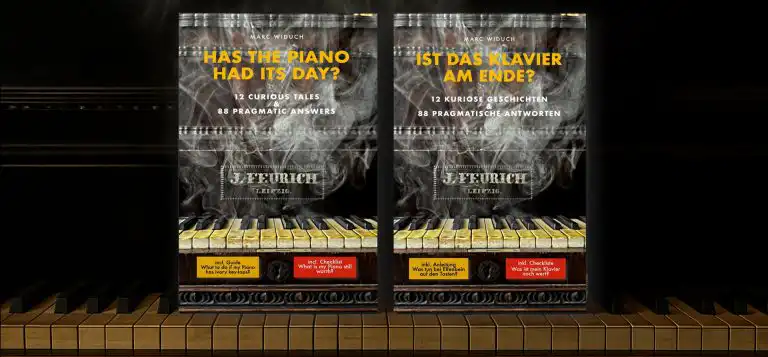
The Piano Book: “Has the Piano Had Its Day?”
12 curious tales and 88 pragmatic answers about the piano, plus the checklists “What is my piano still worth?” and “What to do if there is ivory on the keys?” and personal information about your own instrument. Signed on request – a lovely gift, too. More about the book
Related: How to date a piano · What is my piano still worth? · Piano purchase · Piano appraisal · Pianos for sale