




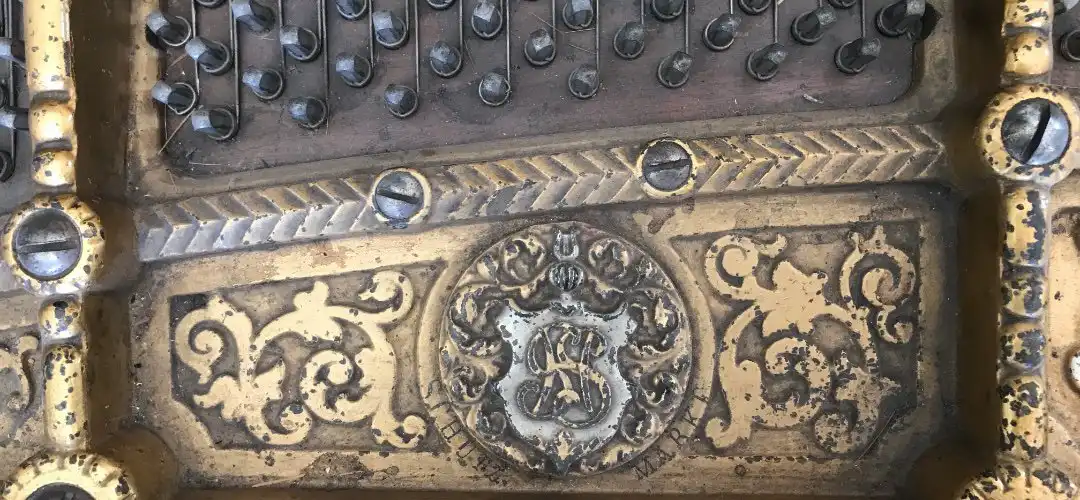
Even though almost every piano can still produce notes regardless of its condition, the statement so common in ads, ‘…just needs tuning…’, is usually not true.
If well kept, even a piano well over a hundred years old can still be in good condition – but as a rule, you should assume there are obvious and hidden defects due to age and use, which may even mean an economic write-off.
We offer an assessment and appraisal of your instrument as a paid service.
A piano basically has three elements, …
the acoustic system
(cast-iron frame, soundboard, stringing including tuning pins, pinblock)
the action, including keyboard and pedal system
the case.
As long as the case has no structural damage (cracks or breaks), only the acoustic system and the action/keyboard are relevant when assessing the condition in terms of playability and sound. When looking at the instrument’s current value and any restoration costs as a whole, the condition of the case also comes into play. If the case has critical damage – or severe pest/mold infestation – the piano is only fit for a living space after professional renovation.
Critical structural damage is usually not easy for a layperson to spot – and often not for experts either. Anything that severely limits or even prevents tuning stability and playability is critical. This includes
While normal signs of wear, e.g. in the action, can be remedied at reasonable cost, structural damage can only be repaired at great expense.
We recommend asking the previous owner when the instrument was last tuned, how regularly it was tuned and at what pitch. The previous piano tuner will certainly also have made valuable observations about how well it holds its tuning. In any case, we recommend taking a piano expert along to viewings, especially when buying privately – ideally also when you buy a piano from a dealer. Besides other standard tools, the expert should bring an air humidity and wood moisture meter to check the situation on site and inside the instrument.