




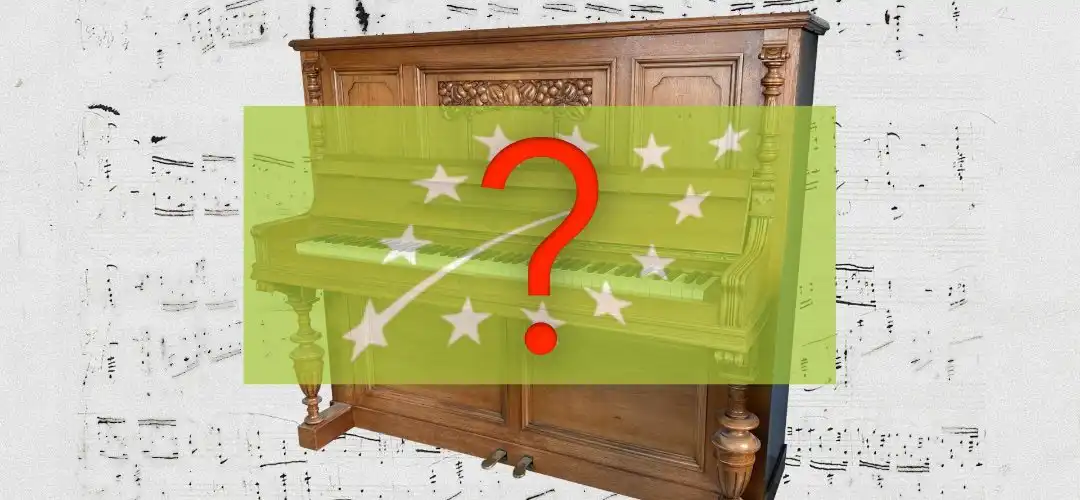
Yes. Really? At least in advertising. Today there are piano manufacturers who advertise “organic piano making” on their website. Or piano manufacturers who advertise a particularly high proportion of handwork. So let’s take a closer look.
We are not aware of any scientific work on this topic – if there are graduate students, doctoral candidates or self-taught researchers who would like to take it on, please get in touch, we will be happy to support you!
What counts as organic is – like everything – a matter of definition. Originally it meant that no artificial substances are used in production or go into the product. In other words, only materials that occur as such in nature, and tools and production methods using substances that occur as such in nature. Presumably not even the first pianoforte at the end of the 17th century was made according to this organic definition.
What in a piano today actually occurs in nature exactly as it is built into the piano? Pretty much nothing. All materials, including wood, are specially grown, treated and processed before they are used in the piano. The higher the degree of industrialization of production – and that probably applies to more than 95% of worldwide production – the greater the depth of processing.
The EC basic organic regulation No. 834/2007 of the Council of June 28, 2007 states: “(…) criteria for certain products and substances in processing: (…) the products and substances referred to in (…) shall be found in nature and may have undergone only mechanical, physical, biological, enzymatic or microbial processes, (…)”. This comes closer to the common understanding of organic. Curious is the addition in the same paragraph: “(…) except where such products and substances from such sources are not available on the market in sufficient quantity or quality.(…)”, source: https://www.bmel.de. This of course opens the door to all kinds of exceptions.
For pianos, then, organic can only mean as organic as reasonably possible. And what is reasonable is again a matter of opinion and definition. It means that as little energy and as few raw materials as possible should be used for the product and its production, the raw materials should as far as possible be naturally renewable and processed in the most environmentally friendly way possible. In addition, pianos should be used for as long as possible, in an energy-saving and emission-free way. They should not be throwaway products, i.e. they should be easy to renovate again and again. Last but not least, the materials used should be recyclable as sustainably as possible when there is absolutely no other use for the piano.
In our assessment, almost all new industrially manufactured pianos fail on these organic criteria.
As with almost all purchases, from an ecological point of view the simple rule applies:
- Doing without can be better than consuming
- Reusing secondhand can be better than buying new
- Sharing and passing on can be better than multiple individual ownership
- Sustainable use is better than waste
- Natural renovation is usually better than heavy use of energy and chemicals
- Ecological disposal is better than incineration
Nevertheless, life also includes joie de vivre – and that includes music, including playing the piano. Doing something better is better than doing nothing better at all. And yes, this website article, its storage on servers and its display on devices also harm the environment. As long as the possible positive contribution is clearly greater and no better solution is in sight, it seems worthwhile.
One example of natural renovation among many: we favor shellac polishes, because this natural material, its low-energy and low-chemical processing, its low emissions and its disposability are so much better than the widely used synthetic lacquers, especially polyester. Quite apart from the authenticity for old instruments and the unique beauty of a hand-polished shellac finish.
In our work over the past decades, we have also gone through many learning curves and are still far from being as ecological as we aim to be. Step by step, we are moving in the right direction. No new instruments, only high-quality instruments, careful transport and storage, renovation as natural as possible, and if disposal – then proper piano disposal, and much more. The learning never stops.