




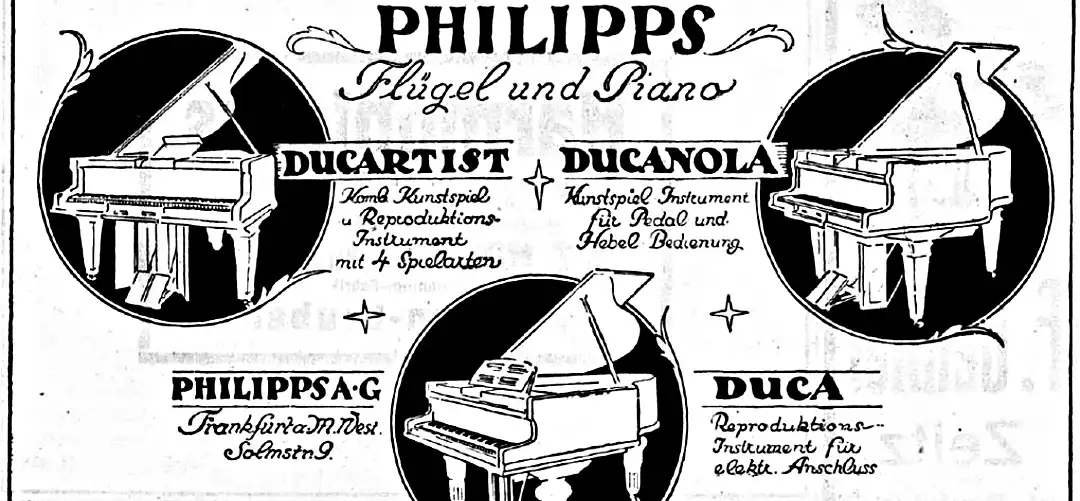
“Pianola” as a collective term for player pianos hardly hints at the great variety of these instruments. This variety is due to the gradual development of technical possibilities and the different demands of buyers – but equally to the large number of manufacturers who wanted a share of this lucrative market. Many of these manufacturers tried to push through their own ideas – or to get around existing patents – and therefore kept building new variants of pianolas that were similar in their basic principle.
The following features can be used to distinguish between the various pianola systems:
Design (cabinet, push-up player, built-in upright or grand piano)
Type (foot-pumped player, expression piano, reproducing piano)
Scale (number of notes addressed at the tracker bar) and
Basically, four different designs can be found: the cabinet, the push-up player (German: Vorsetzer), the pianola with built-in upright piano, and the pianola with built-in grand piano.
THE CABINET
Cabinets are the systems that combined the player technology with an acoustic piano in one case but had no keyboard of their own. The acoustic piano in the cabinet was sourced from leading manufacturers, mostly from Feurich. In these systems, the player technology acts directly on the piano’s action. To our knowledge, these are exclusively reproducing systems that play the music fully automatically and with expression. These systems were particularly suitable for music lovers who only wanted to listen to the music from the rolls and not play the instrument themselves. Cabinets were built by Welte, Philipps and Hupfeld – today they are rarely found, and if at all, mostly by Welte-Mignon.
THE PUSH-UP PLAYER
The so-called push-up players (German: Vorsetzer) were the first systems produced in large numbers. The Pianola of the Aeolian Company and the Phonola of Hupfeld AG are very well-known examples. A push-up player is pushed in front of a hand-played upright or grand piano. The player technology is entirely in the push-up player. The push-up player usually has 65–88 fingers (others/earlier ones fewer), which rest on the keys and thus play the music read from the roll directly via the keyboard. Push-up players existed in all three types: as foot-pumped instruments (early Pianola/Phonola and others), as expression instruments (later Pianola/Phonola and others, with accenting options) and as reproducing instruments (Welte, Hupfeld DEA, etc.). Push-up players are interesting if you want to enjoy the sound of an existing upright or grand piano – or use different instruments with the push-up player.
THE PIANOLA WITH BUILT-IN UPRIGHT PIANO
The makers of player mechanisms soon realized that more and more customers found it cumbersome to set up the push-up players each time, since they not only had to be pushed up to the instrument but also correctly adjusted for height, pedal position and playing strength. In addition, fewer and fewer people wanted the extra piece of furniture in their home. Last but not least, selling combined instruments opened up lucrative additional business for the makers of player mechanisms. So it did not take long before manufacturers such as Aeolian or Hupfeld cooperated with many well-known makers of upright and grand pianos – or later often took them over – and above all offered pianola pianos.
THE PIANOLA WITH BUILT-IN GRAND PIANO
From 1908, pianola systems were increasingly built into upright and grand pianos. With the pianola technology built into the instrument, it could be used both as a hand-played instrument and as a pianola. With pianola grands, it quickly turned out that many customers found the boxes holding the treadles on the grand piano visually too bulky, and that operating the often shortened normal piano pedals was not ideal. On later electrically driven pianola grands, these were no longer necessary, as the suction was supplied by the motor.
In addition to these main designs, there were many other creative player solutions, but they did not catch on. For example, there were under-mounted units for grand pianos, keyboard-top units for upright pianos, etc.
TYPES OF PIANOLA
Three main types can be distinguished
the foot-pumped instrument
the expression instrument
the reproducing instrument
All three types existed in the four designs mentioned above – and in combinations of types in one instrument (e.g. the Hupfeld Tri-Phonola). The exception is the so-called cabinets, as these were mostly designed as reproducing instruments. Pure foot-pumped instruments became rarer from around 1907 and were replaced by the so-called expression instruments. The types differ in the way they play different music rolls.
THE FOOT-PUMPED INSTRUMENT
As a type, it is the simplest and earliest form of the standard pianola. The player mechanism for playing the music rolls is driven by pedaling. The music roll contains only the perforations for the notes taken from the sheet music, no perforations for accentuation, tempo or dynamics. The task of giving the piece of music accentuation and expression falls to the so-called pianolist, i.e. the person sitting at the pianola. Hupfeld wrote specific instructions on operating the levers in one of its manuals (see picture).
With this type of foot-pumped piano, “player” instrument is only partly the right term. The music roll does produce the notes in the right order and combination – but it is up to the pianolist to turn this into a pleasant-sounding and possibly beautifully interpreted piece of music, since the pianolist controls tempo, dynamics and accentuation. Many music rolls carry information for this, so that the pianolist can control dynamics and accentuation as the roll maker intended for the piece. In fact, the pedaling technique is decisive for shaping the music with this type of pianola.
Very soon, expectations of these foot-pumped instruments rose, and customers wanted a musical experience that sounded less mechanical and often lifeless. So around 1907, so-called artist rolls came onto the market – here the notes of the piece are placed on the roll as a particular pianist played it – in other words, the first “recordings” were made. Usually the use of the pedal (right pedal) and the melody accentuation were already provided for and placed on the roll by perforations. Until standardization, this was done in a manufacturer-specific way. The shaping of dynamics and accentuation, however, was still up to the pianolist, who could either follow the dynamics and accent instructions on the roll in the spirit of the recording pianist – or make their own interpretation. To be able to play these artist rolls, expression instruments were brought onto the market.
THE EXPRESSION INSTRUMENT
By extending its functions, the foot-pumped instrument became the expression instrument. Additional functions are: automatic melody accentuation (Solodant at Hupfeld, Themodist at Aeolian, Melodant at Angelus, etc.) and a pedal function (sustain pedal = right pedal), which are also controlled automatically by corresponding perforations on the music rolls. In addition to the levers of the foot-pumped piano, there are therefore usually further levers near the roll box for switching melody accentuation and the pedal function on and off.
From around 1908, expression instruments were the dominant type of pianola. The quality of equipment and workmanship varied depending on the manufacturer. In Germany, Hupfeld dominated this market. Expression pianos were initially mostly foot-pumped – but later also had an electric pump unit, which then offered automatic shut-off, rewind, sometimes a repeat function and sometimes also simple accent functions.
Examples of manufacturer-specific names for expression instruments are: Solophonola by Hupfeld, Pianola Themodist by Aeolian, Ducanola by Philipps, Estrella by Popper, etc.
THE REPRODUCING INSTRUMENT
It was presented as early as 1904 as the “Artist” by Hugo Popper of Leipzig and M. Welte und Söhne of Freiburg. Mr. Welte and Mr. Bockisch aimed to record a pianist’s playing in every detail and reproduce it with a suitable device. Quoting from a Welte company brochure: “However carefully drawn, mechanical music will always sound mechanical; it lacks freedom of movement, natural flow, verve in conception, the often inconspicuous yet so charming changes of tempo. In short, the playing lacks what makes it ‘artistic’, what makes it ‘perfect’. After long study we realized that the only solution that thoroughly eliminates all these imperfections lies in recording the pianist himself and reproducing his playing on a grand or upright piano.”
The special music rolls for reproducing instruments contain all the information for fully automatic playback of the piece. Influence on the playback by the pianolist, as with the expression piano, is neither intended nor possible. The manufacturers achieved the high quality of reproduction in different ways. It follows that reproducing rolls only work, and achieve the intended quality, on the instruments of the respective manufacturer. Reproducing instruments play 80–88 notes and have an additional 10–25 holes in the tracker bar for control. More details on the instruments and the music rolls can be found in the respective sections on these pages. Of particular interest, of course, are those roll recordings that are the only sound documents of a pianist – as with Alfred Reisenauer and many others.
THE MOST IMPORTANT REPRODUCING INSTRUMENTS
Welte-Mignon red (T100) from 1904
Hupfeld DEA (from 1907)
Philipps Duca (from 1908)
Aeolian Duo-Art (from 1913)
Ampico A from 1913
Hupfeld Triphonola (from 1919)
Welte-Mignon green (T98) from 1924
Ampico B from 1929
There were also other reproducing instruments, but – like the Popper Stella of 1908 – they never achieved a significant market share, and almost no reproducing rolls for them exist today.
The Ampico B can be regarded as the last stage of development of these reproducing instruments. In the book “Re-Enacting the Artist”, Larry Givens writes about the Ampico B system: “With its fewer moving parts, its electric roll drive mechanism, its quieter pump and exhaust, its rapid-acting valves, and many other improvements and innovations the Model B Ampico cannot be considered anything less than the zenith of player piano development.”
All reproducing instruments were equipped with an electric pump – integrated into the instruments, as a separate pump in a cabinet or chest next to the instrument, or as a central supply in a separate room. Reproducing systems existed as push-up players, keyboardless cabinets and built into upright and grand pianos. Some reproducing systems could also be used as expression pianos. This is indicated, for example, by the name “Duo” in Duo-Art or “Tri” in Triphonola, i.e. in the case of the Triphonola the three different ways of using one instrument.
Of course, there were many other types in which a piano was operated as a player alongside other instruments – these so-called orchestrions are not discussed in detail here.
SCALE OF A PIANOLA
The scale of a pianola refers to the structure and range of the notes and controls available via holes in the tracker bar. Most upright pianos up to ~1945 had 85 keys; many grand pianos and so-called concert uprights often had 88 keys. At first, pianolas only addressed some of the notes available on the piano.
The most important and most common standard scales for pianolas include the
65-note scale (Aeolian, from ~1897)
72/73-note scale (Hupfeld, from ~1902)
88-note scale (standard, from ~1908)
This aspect of a larger compass for playing pieces of music in their original notation was emphasized by the companies as an important distinguishing feature. With reproducing instruments, too, companies tried to differentiate themselves with the compass (e.g. the Philipps Duca with exactly one note more than Welte), and each manufacturer had its own patents for controlling the expression mechanism, so that different scales were introduced here as well and retained for a long time. It was not until the 1920s that Welte and Hupfeld, for example, offered their reproducing instruments with a scale that corresponded to the 88-note standard scale, at least in terms of roll size. This made it possible to play standard 88-note rolls as well (then only as an expression function).
A frequently cited analysis by Chase & Baker from 1908, based on the 3,838 music rolls in their catalog, showed that significantly fewer pieces of music could be transferred 1:1 from the sheet music to rolls with the 65-note scale. Of the 3,838 music rolls, 1,130 (29%) could be played with the 65-note scale. 2,425 (63%) rolls required a compass of 78 notes, 2,542 (66%) required 80 notes, 2,660 (69%) required 83 notes, 3,676 (96%) required 85 notes, and all rolls could of course be played with a compass of 88 notes. To fit pieces of music onto the 65-note scale, reductions and octave transpositions were made to stay within the 65 notes. This Chase & Baker analysis understandably influenced the decision for a 65-note standard and an 88-note standard scale. Although this standardization was determined in America and only by the leading American companies, the European manufacturers gradually followed suit, above all with the 88-note standard, which was considered modern.
STYLES OF PIANOLAS
Naturally, the various manufacturers tried to build their instruments so that they could achieve more sales on the market than the competition. This shows both in the design of the player mechanism and in the design of the pianola cases. The styling was adapted to the different groups of buyers, markets and tastes of the time. Instruments for private households were designed differently from instruments for use in coffee houses or restaurants. The technical implementation of the player mechanisms – though similar in basic principle – differs from manufacturer to manufacturer, and often not even consistently between the various systems of one manufacturer. Reproducing instruments often came in exceptionally artistic, magnificent cases, some designed by artists and individually tailored to the buyer’s interior style.
Related: How does a pianola work? · A used or a new pianola? · Pianolas for sale · Original music rolls