




The basic principle of all pianolas is the same. Greatly simplified: treadles or an electrically driven suction pump create a vacuum in the closed player mechanism. Via a playback spool and a take-up spool, the perforated paper of a music roll is unwound over the tracker bar, so that the holes punched in the paper uncover the desired notes in the tracker bar. For each note there is a pneumatic (striking bellows), which produces the note via the action (on push-up players via the key), because it is evacuated when triggered and collapses. When paper covers the hole in the tracker bar again, the pneumatic opens again. The way the pneumatics are triggered is solved differently. On instruments with, for example, automatic accentuation, pedal, automatic shut-off and rewind, these too are triggered via holes in the tracker bar and implemented via corresponding pneumatic circuits. Alternatively, this is done with control levers on the pianola according to the information on the music roll or the taste of the pianolist. For separate control of the bass and treble, the wind chests of almost all pianolas from around 1902 are divided into bass and treble roughly in the middle of the keyboard.
HOW THE HUPFELD PHONOLA PUSH-UP PLAYER WORKS
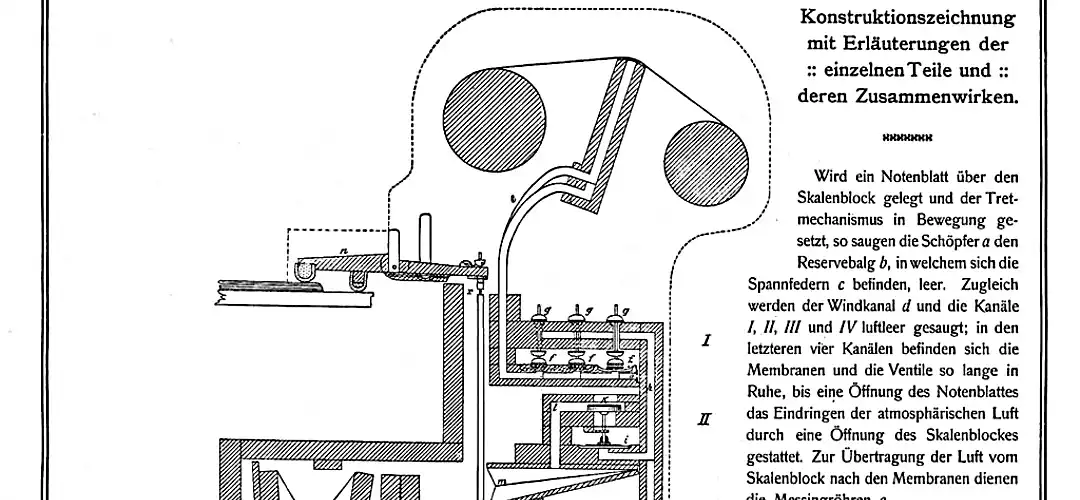
A wonderful explanation is included in the brochure “Phonola Spiel- und Regulier-Anleitung mit Konstruktionszeichnung” (Phonola playing and regulating instructions with construction drawing), which was given to buyers of the Phonola after 1902. This description is quoted here from an original (in translation).
“If a music sheet is placed over the scale block [= tracker bar] and the treadle mechanism is set in motion, the exhausters a evacuate the reservoir b, in which the tension springs c are located. At the same time, the wind channel d and the channels 1, 2, 3, 4 are evacuated; in the latter four channels, the membranes and valves remain at rest until an opening in the music sheet allows atmospheric air to enter through an opening in the scale block. The brass tubes e serve to transfer the air from the scale block to the membranes. The entering air now lifts the small membrane f and with it the small valve g, which closes at the bottom but, through the opening thus created, allows atmospheric air a second time to enter an air shaft h leading to the membrane i. The latter is thereby lifted, and with it the valve k is pressed upward to prevent outside air from entering. At this moment, the air shaft l and the striking bellows m are placed under the influence of the suction, whereby the striking bellows is suddenly drawn in and thereby presses the finger n down onto the keys of the piano. As soon as the opening in the scale block is closed again, all parts fall back into their previous position, with the membrane f releasing its atmospheric air through the small exhaust hole o.” p and q are mentioned in the regulating instructions, as they operate the pedal.
Related: What types of pianola are there? · A used or a new pianola? · Pianolas for sale · Original music rolls