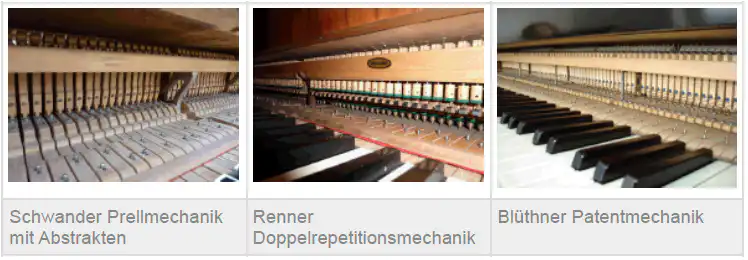

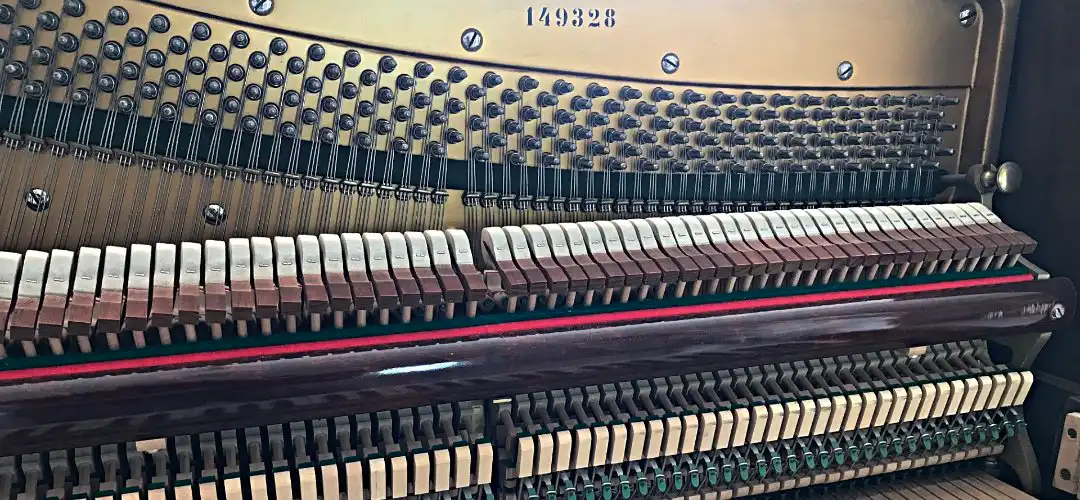
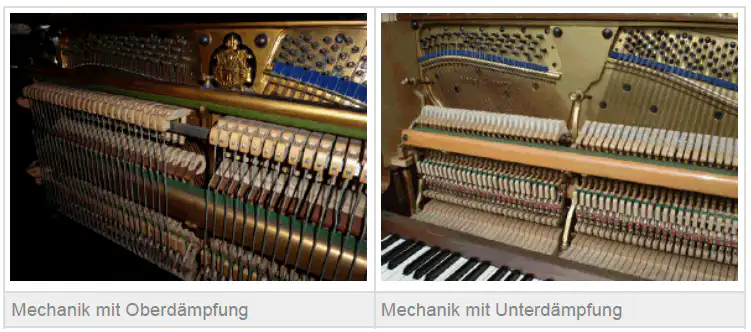
All the types of action still found today can play well. The underdamper action, standardized since the beginning of the 20th century, is the usual one today. The Renner company has been one of the best known since the 1920s – and was recently taken over by Steinway & Sons.
In our experience, Ibach and Blüthner overdamper actions from the period up to around 1920 also play very well. Incidentally – the underdamper came first (for example at Erard and Pleyel before 1850) – after that, the overdamper was favored in Germany because of its better playability and damping, only to be replaced again later by the underdamper once action parts (above all spring steel) were more readily available.
There were also various types of action for grand pianos, which in turn were implemented differently by different manufacturers. A rough distinction can be made between the early Prellmechanik / stoss action (including the so-called “Viennese action”), which did not allow fast repetition and, in the case of the Viennese action, had a more elaborate type of damping, and the later double repetition action (the so-called “English action”) based on the inventions of Erard and Herz.
In the double repetition action, still built today, the wippen is moved via a capstan (the connection between the end of the key and the action). Some manufacturers also connected the key and the wippen firmly (tracker-style action), which allows greater precision – but is more complex to renovate and adjust. Although a renovated instrument with a Prellmechanik is of course also lovely to play, for contemporary playing we would always recommend the modern action with underdampers. A notable exception is the Blüthner patent action, which in good condition allows very light, controlled and fine playing and also repeats wonderfully for high demands. The success of this type of action is shown by the fact that, although Blüthner offered the Blüthner Erard action on request from the 1870s onward, the patent action is found more and more often up to the 1920s.
PICTURES OF A GRAND PIANO ACTION