




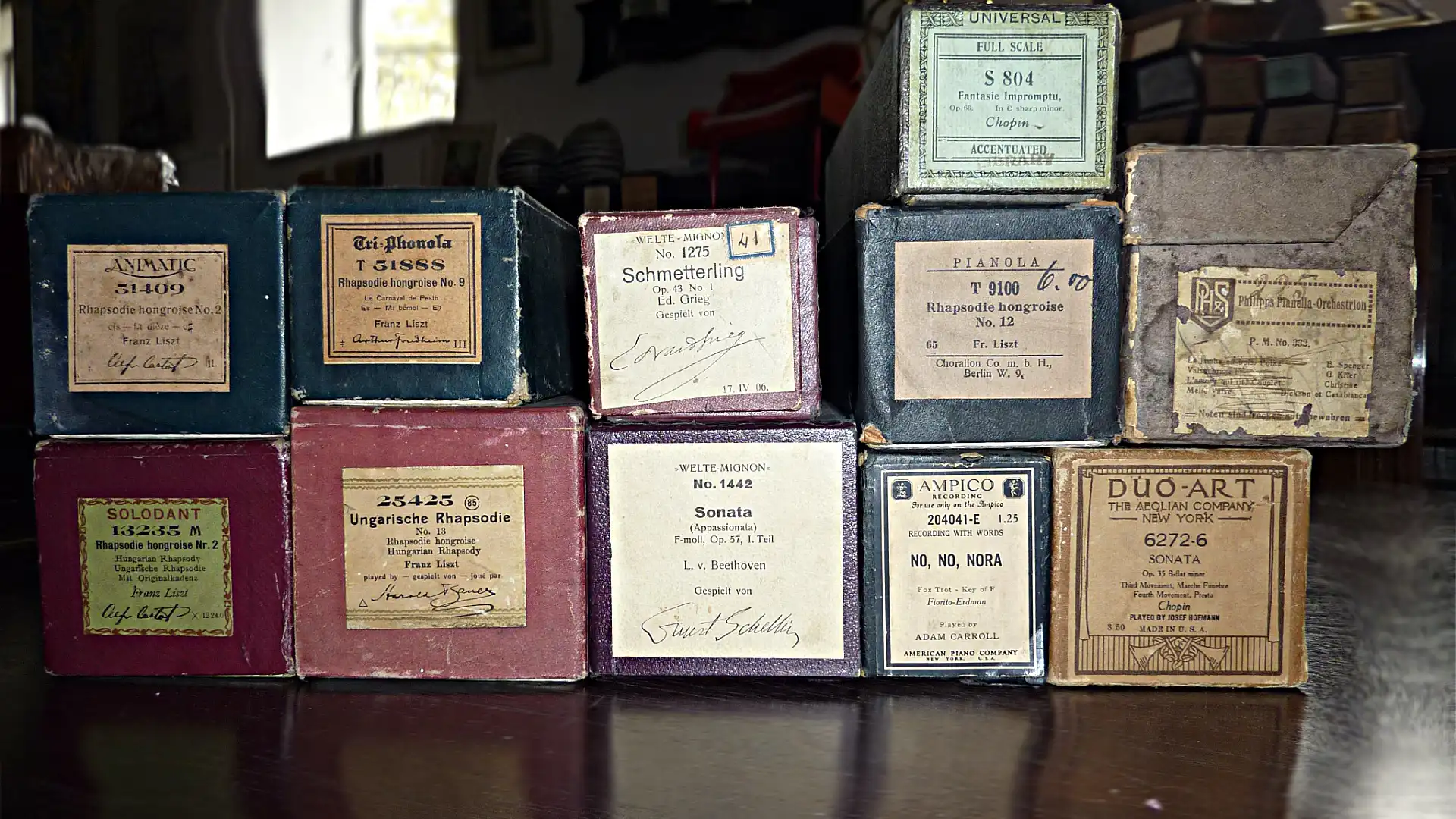
As with pianolas, music rolls differ considerably by manufacturer, age and type. There are numerous different roll types, and each only fits certain types of pianola. The value of the rolls that survive today also varies greatly, depending on how many of them still exist and how many potential buyers there are.
The following features can be used to distinguish the many types of music rolls:
Roll type (drawn rolls, artist rolls)
Scale (standard: 65-note and 88-note, as well as manufacturer-specific: 72-note, T98, T100, etc.)
Titles (beauty, quality and rarity of the pieces of music)
ROLL TYPES
The roll type describes how the music roll was made. Although manufacturers used all kinds of terms for advertising purposes to stand out, essentially two types of roll can be distinguished: drawn music rolls that were not played in, and recorded artist rolls.
DRAWN ROLLS
Drawn music rolls were transferred directly 1:1 from the sheet music to music rolls by so-called roll arrangers. Arranged rolls additionally contain editorial intervention to adapt the piece more to the taste of the time. These drawn rolls (also arranged rolls, ordinary rolls) were meant to give the pianolist the greatest possible freedom in interpreting the piece. Here, too, there are already different rolls of the same piece, since the notation depended on the edition of the respective piece. Drawn rolls exist in very large numbers for 65-note, 72-note and 88-note systems. This type of roll became established above all in the USA.
ARTIST ROLLS
Recorded music rolls were created by recording a pianist’s original playing on special recording grand pianos – and usually also editing it afterward. These rolls usually bore the pianist’s signature to document that the roll represents the pianist’s playing. At Hupfeld and other manufacturers, these rolls were called artist rolls (Künstlernotenrollen). Welte issued only recorded rolls. At Aeolian, these rolls bore the inscription “hand played”.
Manufacturers produced artist rolls in two variants. As artist rolls for expression pianos, i.e. the music rolls contained the pianist’s recorded hand playing, the melody accentuation and the sustain pedal. Further dynamics are up to the pianolist. This roll type was produced in large numbers – for example the Phonola and Animatic rolls by Hupfeld, the Ducanola/PhilAG rolls by Philipps. The second variant is the much rarer reproducing rolls – these contain all the information required for fully automatic playback, including every detail. This roll type includes Welte-Mignon rolls, DEA rolls, Tri-Phonola rolls, DUCA rolls, Duo-Art and Ampico rolls.
However the recording was made – assuming good quality – the decisive factor for a roll of very good quality was the editing process, also with the participation of the pianist/composer. Even if this editing did not aim to change the recording but only to make technical corrections. In this way, a really very good result was achieved for some rolls through editing.
As with today’s artist recordings, however, there was often also the striving to optimize the recording by perfecting individual passages, raising the tempo, etc. From the point of view of interpretation, intensive research and discussion continue to this day to clarify the authenticity of the roll recordings. Audio recordings from the same period clearly show that the original playing was indeed captured very well, although with the first audio recordings, too, the artists strongly adapted their playing to the recording technology. Regardless of all these technical details, subjective perception remains the decisive factor in enjoying music.
SCALE
The scale describes the structure (number, width and position) of the perforations on the paper, i.e. the number of notes, the possible control information for melody accentuation and pedal, and any additional control information for reproducing functions. As a result, the roll paper widths used by the different manufacturers also vary considerably. In addition, the roll flanges and the pins or recesses for mounting the roll on the sides differ. Only the 65-note and 88-note standard rolls can be played on all standard 65-note and 88-note pianolas. All other rolls only fit the respective manufacturer’s instruments, e.g. the 72-note Phonola roll only fits the Hupfeld Phonola. The scales of the reproducing pianos were all manufacturer-specific, i.e. no roll is compatible with another system. The different scale formats are described in separate sections.
ROLL TITLES
The market leaders quickly signed up the most important pianists and composers – not necessarily exclusively by contract, but de facto exclusively in cases where these artists did not record elsewhere. Some pianists recorded on almost all systems, e.g. Oswin Keller. With such a huge repertoire, however, numerous titles also had to be recorded for which no well-known pianist was available. So Hupfeld, Philipps and all the others had house pianists, as it were, who were often not even named – the main thing was that the rolls could be issued as artist rolls. Just as today, manufacturers back then published the most modern music, the latest hits, the hottest artists. The big manufacturers also tried systematically to offer rolls for particular target groups, e.g. regional titles, accompaniment music, dance music, marches, etc. Manufacturers tried to retain customers with subscriptions. At the height of the boom, hundreds of thousands of titles were issued – an oversupply that understandably led to price wars. Because the heyday of the pianola was so short, the titles available were less decisive in the end – economically, the most successful were those who conquered the market first, above all Welte.