




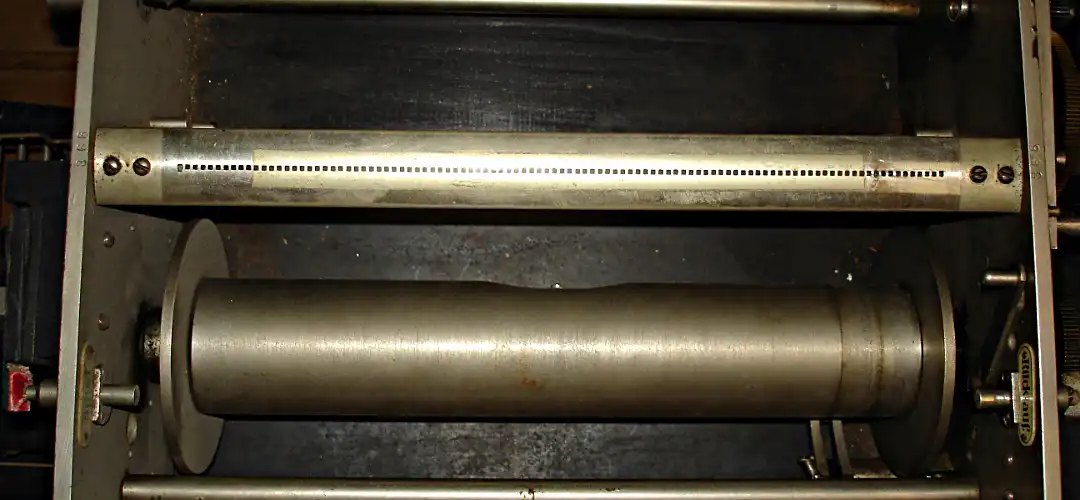
Philipps AG in Frankfurt launched the DUCA reproducing system in 1908. How important unique features compared with the main competitor were even then is shown by the fact that this DUCA reproducing system was advertised as the one with the largest compass at the time, 81 notes (Welte then had 80).
This system, too, used its own roll format – the narrowest of all reproducing systems, on the grounds that these narrow music rolls were better protected against expansion in humid weather. Today, more than 100 years later, this has proved to be quite correct. Like Welte and Hupfeld, Philipps tried to feature big names in its music roll repertoire – it succeeded, but not to the same extent as Welte and Hupfeld. Nevertheless, DUCA also built up a very large and attractive repertoire, especially up to 1913.
Here is a video of a pneumatic DUCA roll reader for digitizing the original music rolls.
Hier klicken, um den Inhalt von YouTube anzuzeigen.
Learn more in YouTube’s privacy policy (opens in a new tab).
Technically, the DUCA system is very sophisticated and plays very well if it has been faithfully restored and well regulated. It shows clear parallels to Welte – to this day it remains unclear whether patents were used with permission. Philipps has some technical refinements that are an advantage over other manufacturers.
The DUCA scale has 102 almost uniform holes in the tracker bar – 81 of them for the notes and 21 for control, 11 on the right and 10 on the left. Philipps DUCA reproducing systems are found more often in Feurich upright and grand pianos and in Arnold pianos – the latter one of the piano factories that Philipps bought up in the late 1920s.
Since Hupfeld and Welte initially had no suitable offerings for restaurants and cafés, Philipps offered its coin-operated instruments there. Worth mentioning is the Philipps revolver mechanism, which was built into its instruments as early as 1911 – and could play six music rolls automatically one after the other. Equally innovative was the so-called water motor for locations with no electricity or no reliable electricity – this water motor could be connected to an existing water pipe and also activated by coin.