




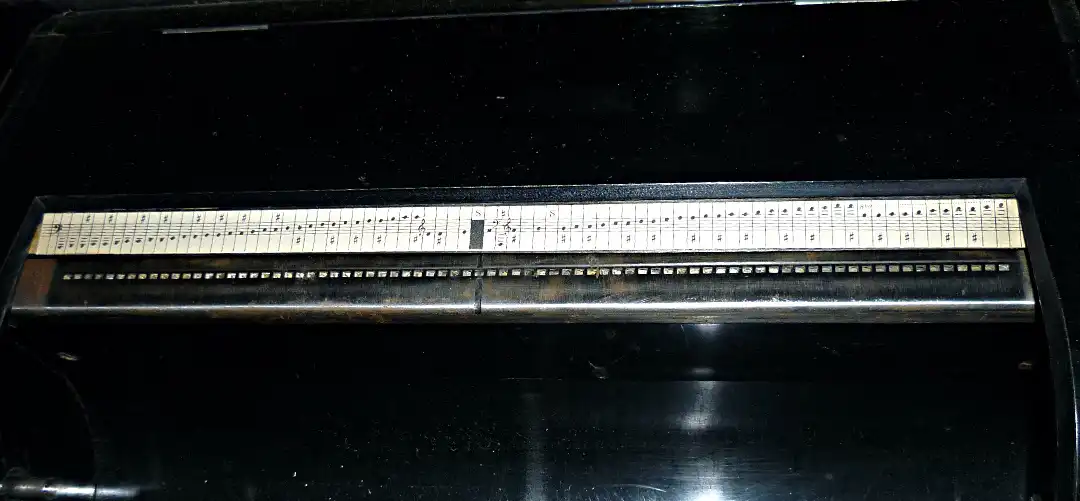
The scale, actually a 72-note scale, was launched by Hupfeld around 1902 to offer a larger compass and a divided wind chest (separate dynamics for bass and treble) compared with its main competitor Aeolian. In its advertising, Hupfeld initially deliberately always spoke of only 72 notes – although many Phonola instruments played 73 notes. The scale ranged from F1 to f3 – but by default without F#1. This note was, so to speak, an extra on hole 39 (instead of hole 2) of the tracker bar. The background is that Hupfeld wanted to keep the remaining max. 5 holes (there are 77 holes in the tracker bar) free for instruments related to the Phonola (above all the Phonoliszt, but also the Clavitist/Universal, etc.) in order to map control functions there.
On the Phonola, staff lines were often also attached above the tracker bar so that the assignment to the holes could be followed.
In 1908, Hupfeld launched a significant innovation with the Solodant function, i.e. accentuated melody lines. A manufacturer-specific feature is the arrangement of these accent perforations in the middle of the roll at Hupfeld (at Aeolian at the edge, see above).
In 1908, Hupfeld aggressively targeted the customer base of its competitor Aeolian with the option of also playing 65-note rolls on the 72-note Phonola by means of a switchable scale.