




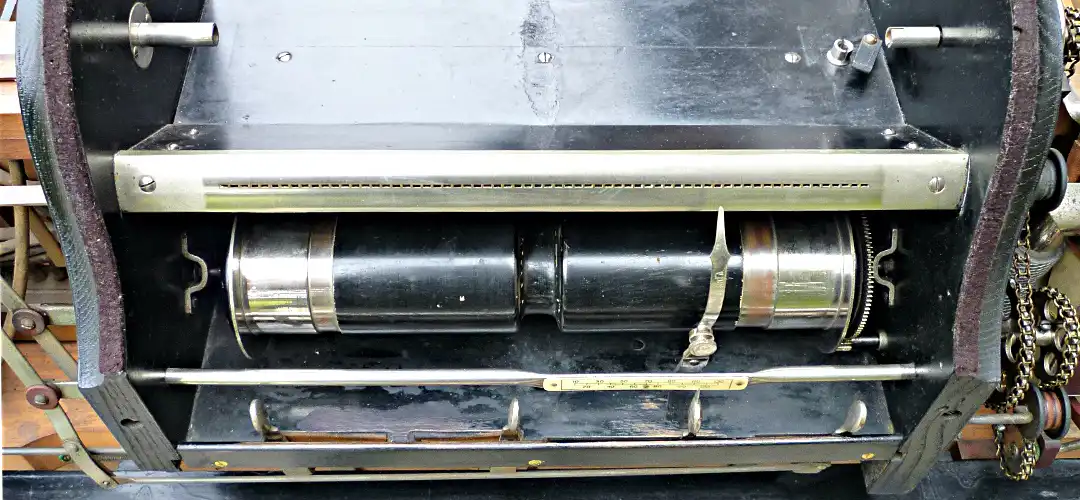
The 65-note scale was marketed by Aeolian in America from as early as 1897 with the Pianola push-up player and came onto the German market even before the Hupfeld Phonola. However, the head start of the first mover Aeolian could not be sustained economically, at least in the German market, which was strongly dominated by German companies. One reason was that the Pianola push-up player cost considerably more in Germany, at 1,250 Reichsmarks, than the Phonola (850 Reichsmarks), and with only 65 notes it had a smaller compass. As described, however, the product name “Pianola” has become established as a generic term for these player systems.
The scale of the 65-note Aeolian system initially comprised only the 65 notes.
Only after Hupfeld did Aeolian introduce the Themodist, i.e. the automatic accentuation of melody notes. Since the paper width of the 65-note roll was already used extensively, only small double perforations (nicknamed “snakebite”) at the very edges could be used for melody accentuation in the bass and treble.