




Around 1900, neither Hupfeld nor Welte nor any other manufacturer can have imagined that their music rolls would still be playable more than 100 years later. After two world wars, many crises and decades of sometimes difficult climatic conditions, a surprising number of music rolls are still well preserved. In recent years, scholarly interest in the production methods, materials, repertoire, etc. of the time has also grown. Significant research results have been achieved in Bern/Seewen since 2000. The Global Piano Roll Meetings connect many experts around the world and offer a forum for gaining further important insights and making lost titles accessible.
Were Welte red papers always red?
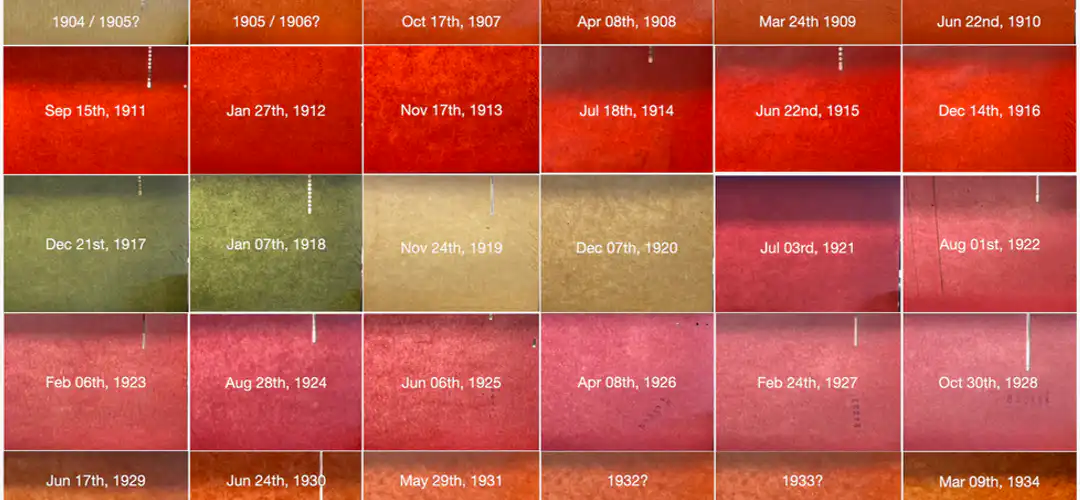
No. At first, Welte used existing papers, e.g. brown ones from orchestrion production, and during the turbulent times around the First World War, whatever material was available and permitted in the war economy was used, e.g. white, brown or green papers. Nevertheless, the name Welte “red” became established, since the typical red paper was used for most of these music rolls. Since Welte had to reorder paper several times over the years, apparently changing both suppliers and qualities, there are “Welte red” rolls in different colors. The typical red paper that gave them their name was found above all in the heyday of the Welte-Mignon (1907–1912). During World War I it was even redder, but of poorer quality; in the 1920s it was rather pink and very thin; and in the 1930s it was rather orange and thicker.
What is the oldest Welte-Mignon red roll?
Unfortunately, this has not yet been clarified – and probably can no longer be clarified. According to current knowledge, roll production for sale began in 1905 and only reached professional dimensions in 1907. The most important pianist for Welte in the early experimental phase of 1904 was Eugenie Adam-Bénard (1864–1956). The oldest surviving Welte-Mignon red music rolls are probably the ruled brown and red rolls without any date on the roll – still from internal use at Welte. These rolls have rather large holes and quite coarse and imprecise perforation. So far, a music roll produced on March 9, 1934 is the last Welte red roll found.
How can a Welte-Mignon red roll be dated?
From 1907, almost all Welte music rolls bear a handwritten production date at the very end of the roll on the right. If this date is missing, the roll can be roughly dated from the paper used. Before 1907, there is usually only a name there. The earliest music rolls apparently bear no notes.
Why are there so few rolls from 1905 and 1906?
This can probably be explained by the fact that production and sales of the playback instruments (initially only the cabinet without keyboard) got off to a slow start. Feurich supplied the piano components to Welte in Freiburg at the time. From its production books we can deduce that fewer than 30 Welte instruments were completed in 1905 and probably fewer than 100 in 1906. How many of them were sold in 1905/1906 is unclear. Accordingly, it is not to be expected that many music rolls were sold in 1905 and 1906 – and probably very few of them still exist today. It was not until 1906 that a sales catalog for Welte red rolls was issued to dealers, already containing several hundred titles.
Do you have music rolls or information for us?
Together with many experts around the world, we continue our research to understand better and better how music roll production worked back then. We also digitize these rolls and offer new music rolls based on the original models. If you have information or music rolls for us to support these activities, please contact us.