




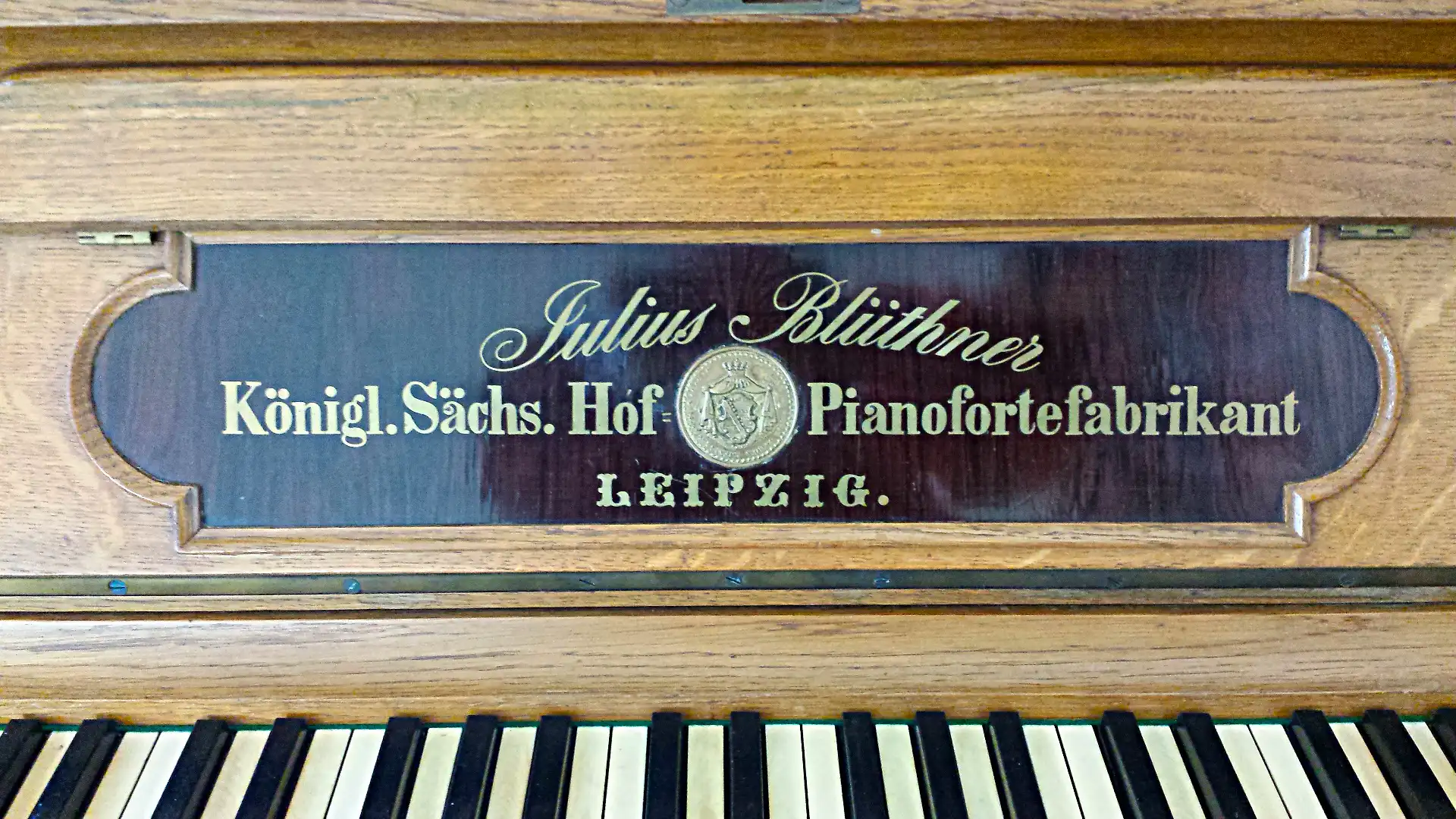
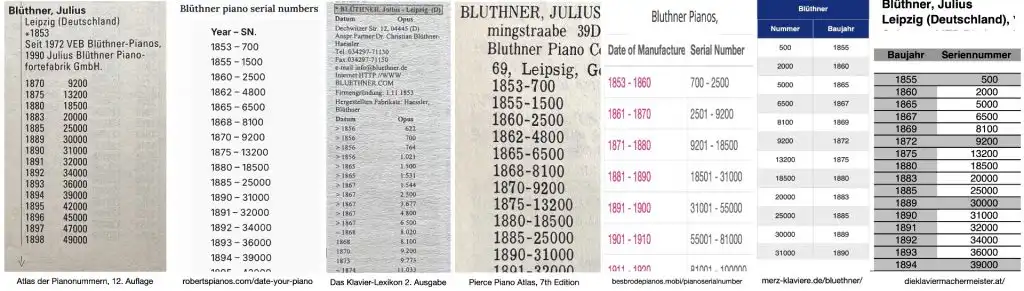
For early Blüthner instruments up to around 1880, the serial number information in most specialist publications is wrong, i.e. especially for the first years, the figures given are far too high, or instruments are dated as too old. We have long been working mainly with older Blüthner instruments and here present what is probably a more accurate chronology of early J. Blüthner instruments with corresponding evidence, which has been confirmed in principle by kind feedback from Blüthner GmbH Leipzig and several colleagues.
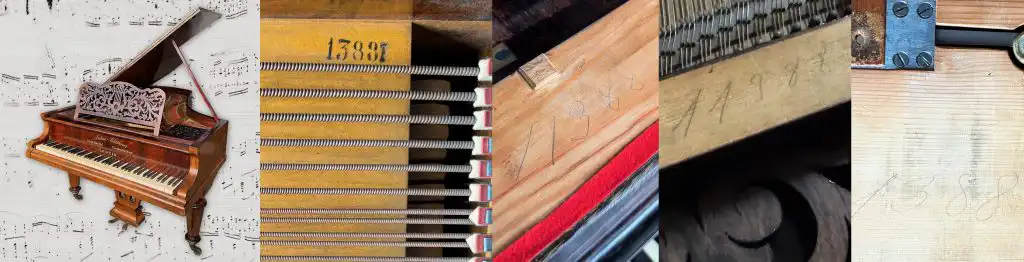
We would be delighted if you could send us further documents or pictures of Blüthner instruments with serial numbers below 10,000, especially below 1,000, to support our work on this topic. Incidentally, we are also interested in buying beautiful early Blüthner instruments and further documents. This is part of the original Blüthner documents on which our research is based, alongside a large collection of data on surviving Blüthner pianos.

In general, serial number lists – where they have survived at all – only give an approximate time as the year of manufacture, also depending on when the manufacturer assigned the numbers during production, e.g. when a frame or the back was made, or only at the so-called “wedding”, i.e. when the back and frame were joined, etc. Work was often done in advance and a component only used, or reused, later, which can also result in conspicuous deviations. Delivery to the company’s own showrooms or to a dealer usually took place later, and even back then new instruments sometimes stood in the showroom for a long time before they were first sold. So a serial number does not always indicate the exact time of completion. In addition, in the used piano trade of the 19th and early 20th centuries, the practice of altering serial numbers afterwards in order to offer an instrument as younger and therefore more valuable already existed. Here is an example of a poorly manipulated Blüthner instrument in our stock.
Julius Blüthner was born on March 11, 1824 in Falkenhain in the Lossatal, about 40 km northeast of Leipzig, and died in Leipzig on April 13, 1910, at what was then a ripe old age of 86. Before founding his own piano factory on November 7, 1853, he had completed an apprenticeship as a cabinetmaker with his father, worked as a cabinetmaker in Zeitz – and at the piano factories Hölling und Spangenberg (Zeitz) and Bretschneider (Leipzig) (source: Wikipedia).
He founded his company with “brilliant references and a fortune of 1,660 thalers, 2 new groschen and 1.25 pfennigs” in a rented workshop and started with 3 cabinetmakers with the aim of making “new fortepianos and grand pianos of German and English construction” and then selling them (source: Blüthner brochures). German and English construction referred above all to the types of action common at the time.
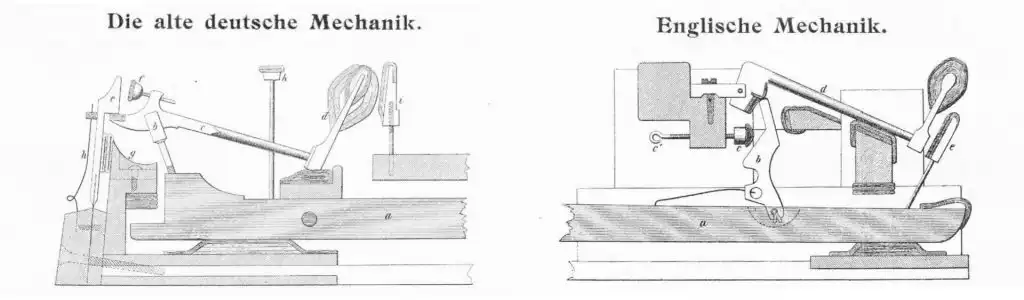
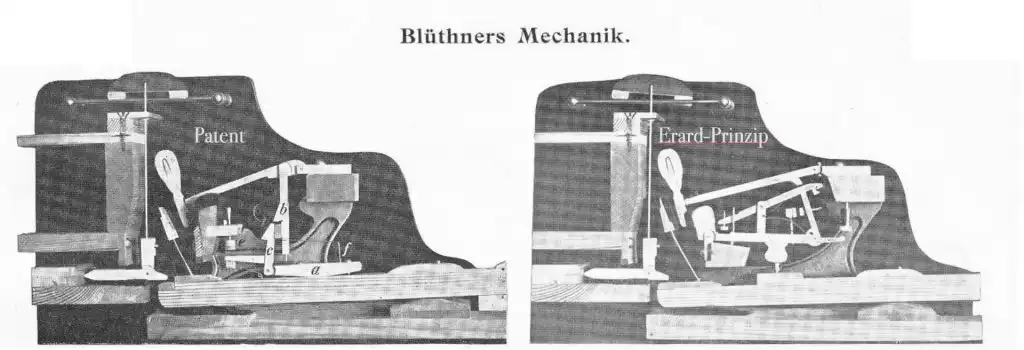
As early as July 6, 1856, Julius Blüthner received a patent for the action he had developed himself, which is still called the Blüthner patent action today. Early on, however, Blüthner also offered an action based on the Erard principle, which customers could choose and which is often found in early Blüthner concert grands. An 1876 report states: “Three quarters of the grand pianos produced are fitted with Blüthner’s patent action; the others receive actions based on the ingenious, pleasing systems of an Erard, a Steinway.”.
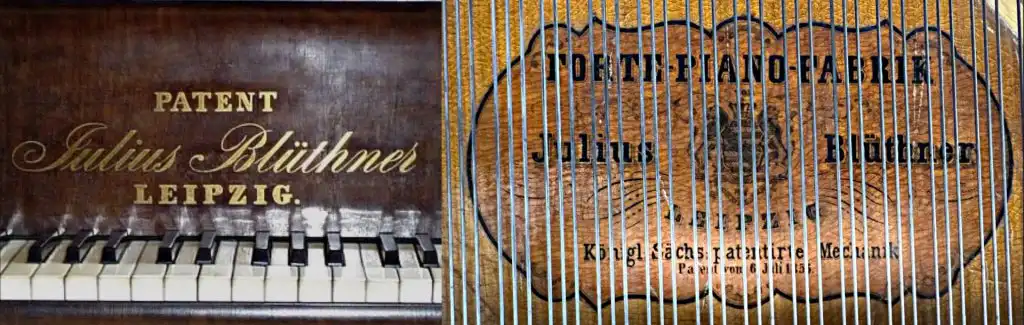
For dating – in addition to design details – important clues can be found in the lettering on the fallboard and on the soundboard emblem, since Blüthner – like most piano manufacturers – advertised prizes and awards on the instruments immediately after they were conferred. Blüthner received these first awards (source: anniversary publication, 1903):
1854 Trade Exhibition in Munich
1856 Patent for the action
1865 Saxon-Thuringian Trade and Industrial Exhibition in Merseburg
1865 Appointment as Purveyor of Pianofortes to the Royal Saxon Court
1867 First Prize for Northern Germany at the World’s Fair in Paris
1867 First Prize, Industrial Exhibition in Chemnitz
1870 First Prize, General Industrial Exhibition in Kassel
1871 Appointment as Royal Saxon Kommerzienrat (Commercial Councilor)
1873 Highest award, Vienna World’s Fair
1873 Patent for Blüthner’s Aliquot piano
1876 Centennial Medal at the World’s Fair in Philadelphia for 6 Blüthner pianos with the Aliquot system
Blüthner instruments before 1856 bore only the name Blüthner Leipzig and no awards, or possibly a reference to the Trade Exhibition in Munich. According to kind information from Blüthner in Leipzig, there is a surviving Blüthner piano with serial number 12 and also other pianos with two-digit serial numbers. However, to date we have no photos of a Blüthner piano built before mid-1856.
All instruments built after July 6, 1856 bear the inscription “Patent Julius Blüthner Leipzig” on the fallboard and, on the soundboard, an emblem reading “Forte-Piano-Fabrik von Julius Blüthner in Leipzig – Königl. Sächs. patentierte Mechanik – Patent vom 6. Juli 1856” (Fortepiano factory of Julius Blüthner in Leipzig – Royal Saxon patented action – patent of July 6, 1856).
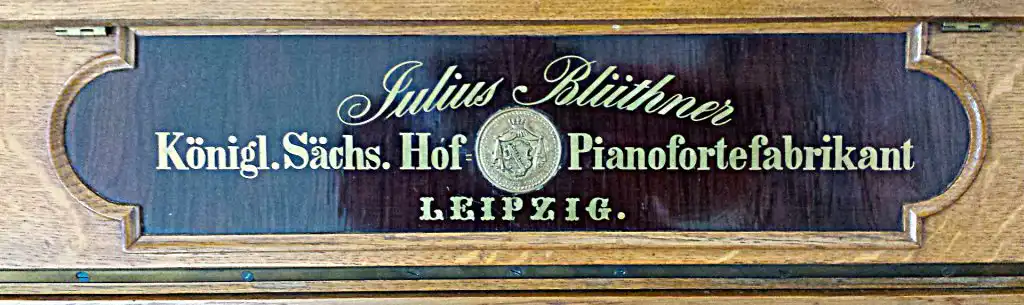
The next visible change in the lettering only came from 1865, after his appointment as Purveyor of Pianofortes to the Royal Saxon Court. Blüthner instruments from 1865 bear “Julius Blüthner König.Sächs. Hof-Pianofortefabrikant Leipzig” on the fallboard, with a plaque between “Hof-” and “Pianofortefabrikant” that can also be seen on the certificate of appointment. On the soundboard, the emblem with the reference to the 1856 patented action continues until 1867.
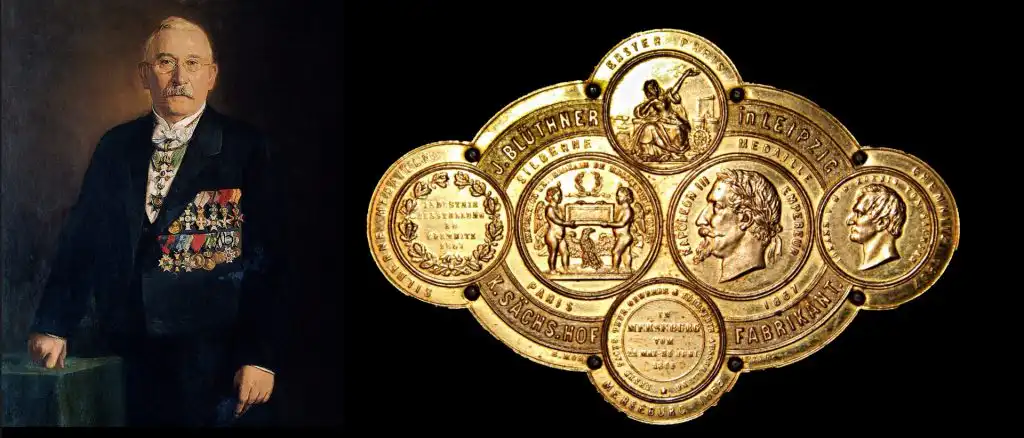
Only in 1867 does the emblem on the soundboard also change, now also showing the awards from Paris and Chemnitz. In addition, from 1867 upright and grand pianos often feature magnificent brass plaques, which also show the awards from Chemnitz and Paris.
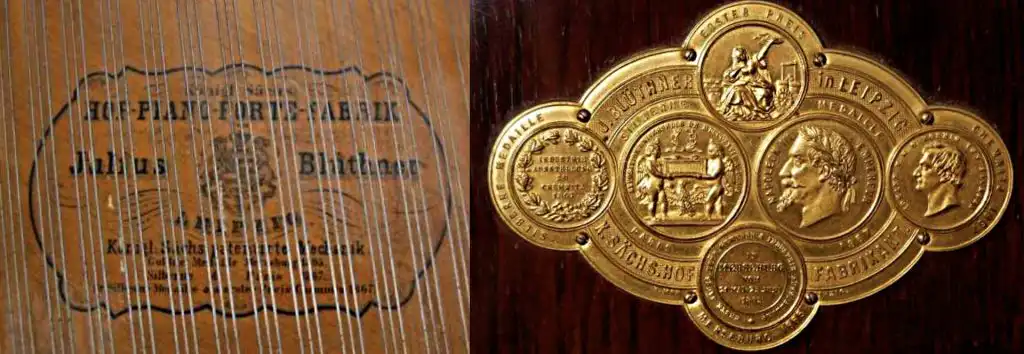
The soundboard emblem changes again in 1870 with the addition of the prize awarded in Kassel, and the lettering on the fallboard also changes, so that only Blüthner appears. At all times during this not yet industrial production, mixed forms of various combinations can also be found, presumably depending on the progress of production and the materials available.
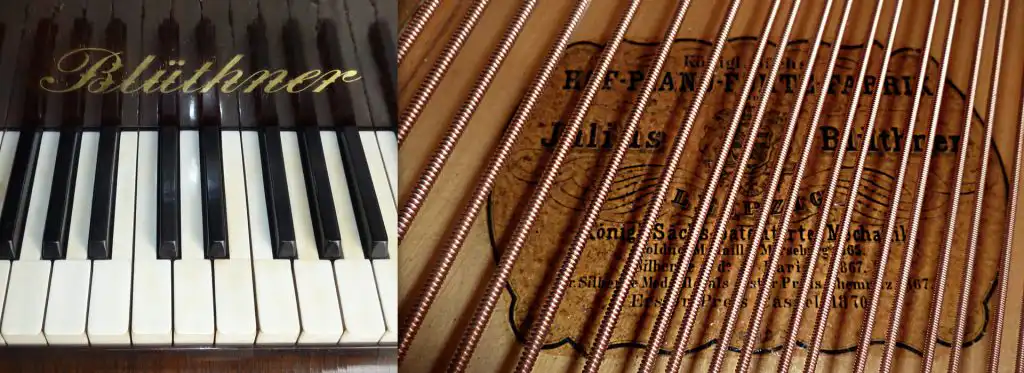
The next change came from 1876, after prizes had been won at the World’s Fair in Philadelphia (USA) for the Aliquot patent invented in 1873. From then on, this too was shown on the soundboard emblem with many medals and dates – and often also on a separate metal plaque.
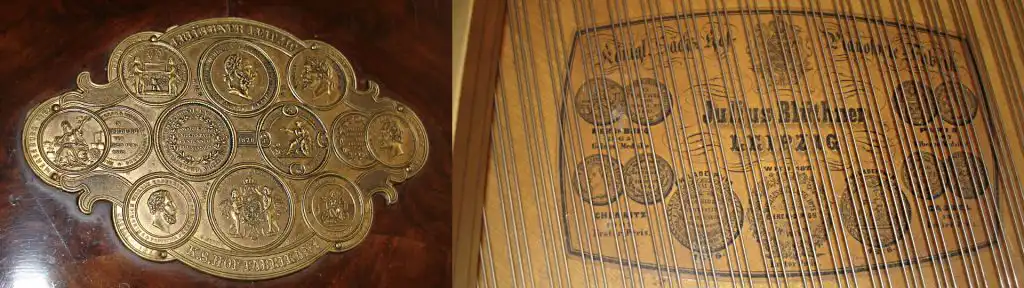
The Aliquot system is still Blüthner’s trademark today. Over the years, the design of the Aliquot has changed again and again. The earliest grand piano known to us, serial number 15747, already had the Aliquot system. Until around 1885, the treble bridge was made in one piece and the Aliquot stringing was divided between the treble bridge and the additional Aliquot bridge. After 1885 the design changed slightly; from around 1895 the implementation has remained essentially the same to this day.
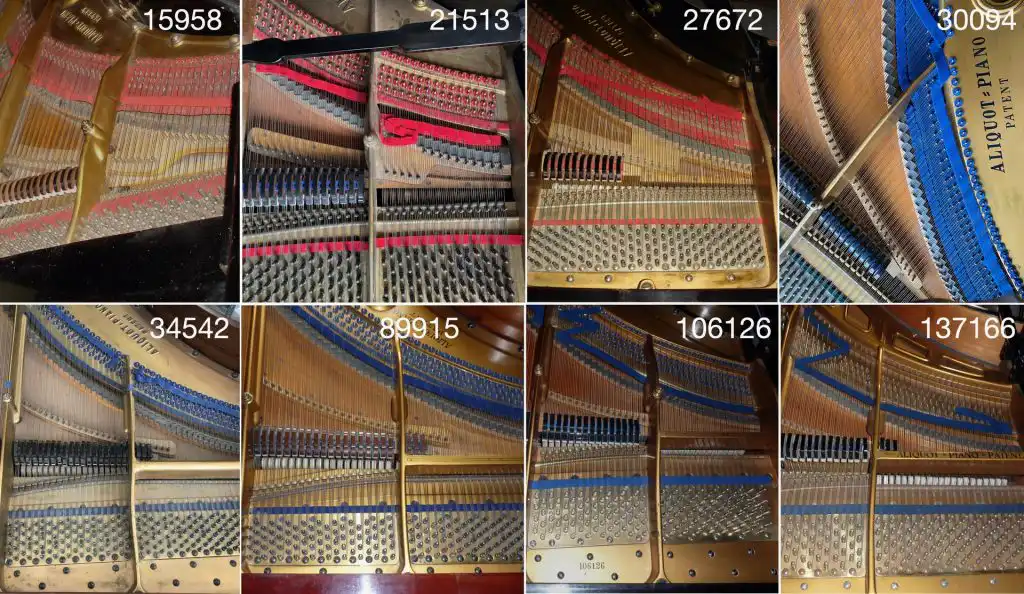
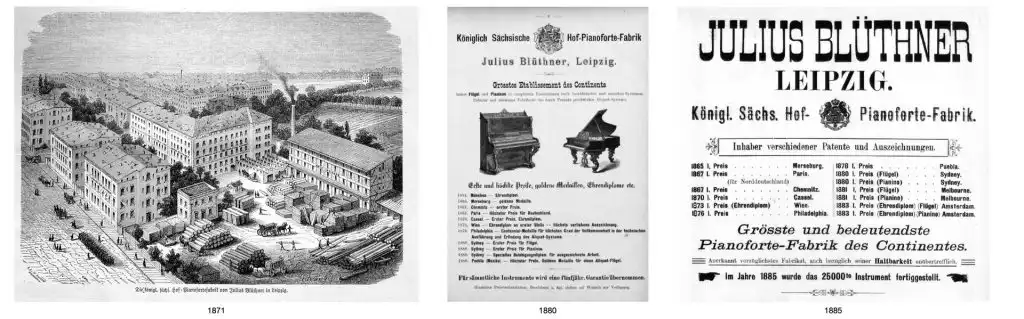
The emblems continued to change later with further awards. Dating Blüthner instruments from around 1880 on the basis of the serial numbers given in the specialist literature is more reliable. This is also because, from the early 1870s, Blüthner increasingly became one of the leading piano factories with industrial production, and there are more and more reports about Blüthner and Blüthner advertisements with details, such as the advertisement from 1885 celebrating the 25,000th instrument. A large article in the “Leipziger Illustrirte Zeitung” from 1871 describes the Blüthner piano factory enthusiastically, stating among other things: “…four large halls for storing the instruments in progress, 6 large halls for exhibiting the finished instruments (…) In the ground-floor rooms the backs (corpora) for the instruments are made, and then each instrument passes through the various departments until, in finished form, it can be presented to the head for final inspection.”.
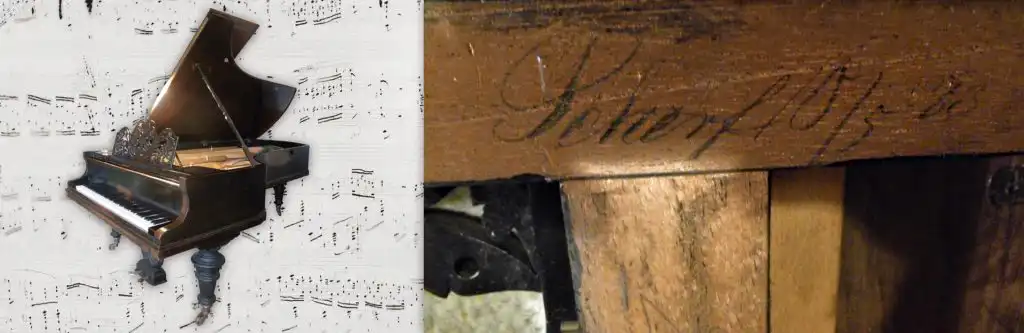
In addition, from this time on, almost all Blüthner instruments bear handwritten notes by the finishing polisher, who was usually the last person to work on the instrument, so that this can be regarded as the actual completion date of an instrument. On Blüthner grand pianos, this note can be found on the underside of the pull-out music desk.
In 1880, Oscar Laffert founded the Zeitschrift für Instrumentenbau, published by Paul de Wit, which quickly became the central “advertising organ of the first rank”, especially for piano making, and is therefore one of the most valuable sources for us today. In May 1876, Oscar Laffert wrote a thirty-page report on the Julius Blüthner piano factory. It states: “After working for a time in various piano factories, he began working independently with 3 workers on November 7, 1853. In February 1854 the first grand piano was finished, in March the second, and so on, one instrument in each of the following months. (…) In February 1862 the five-hundredth instrument was completed.”. The anniversary publication of 1903 states: “The three workers were diligent cabinetmakers and worked to the best of their abilities, but the young master, in his zeal, hardly allowed himself the necessary sleep. When his men came to work at 6 o’clock in the morning, he had already been working on the models for two hours and stayed at work until 10 or 11 o’clock at night. In such intense work, ten instruments were made in the first year, eight grand pianos and two square pianos.”. Taking all these clues together, the following list of early Blüthner instruments emerges, which differs considerably from what has been found in the literature so far.
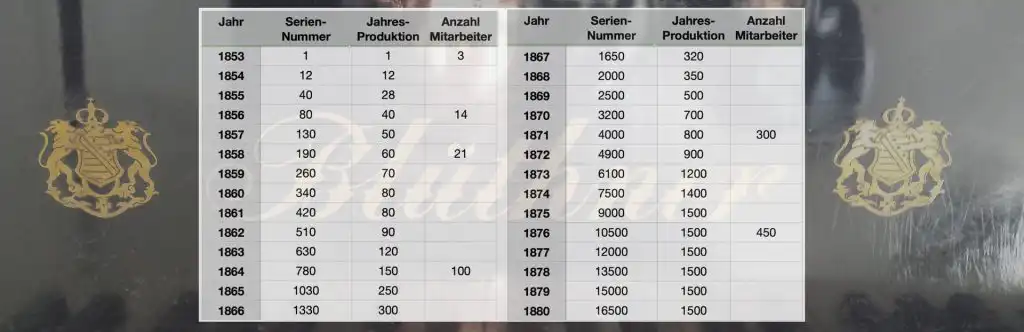
Further research will refine the picture. Incidentally, we find similar things with other manufacturers. Even if this shows that many an instrument is younger than previously thought, it does not change the value or significance of such an instrument. It is always a pleasure to play and hear a well-restored early Blüthner piano. A beautiful example can be seen in this video, in which the pianist Ragna Schirmer plays the restored Blüthner grand piano no. 486. According to our research it is not from 1856 but from 1861 – but a wonderful early Blüthner nonetheless.
The Piano Book: “Has the Piano Had Its Day?”
12 curious tales and 88 pragmatic answers about the piano, plus the checklists “What is my piano still worth?” and “What to do if there is ivory on the keys?” and personal information about your own instrument. Signed on request – a lovely gift, too. More about the book
Related: How to date a piano · Piano appraisal · Pianos for sale