




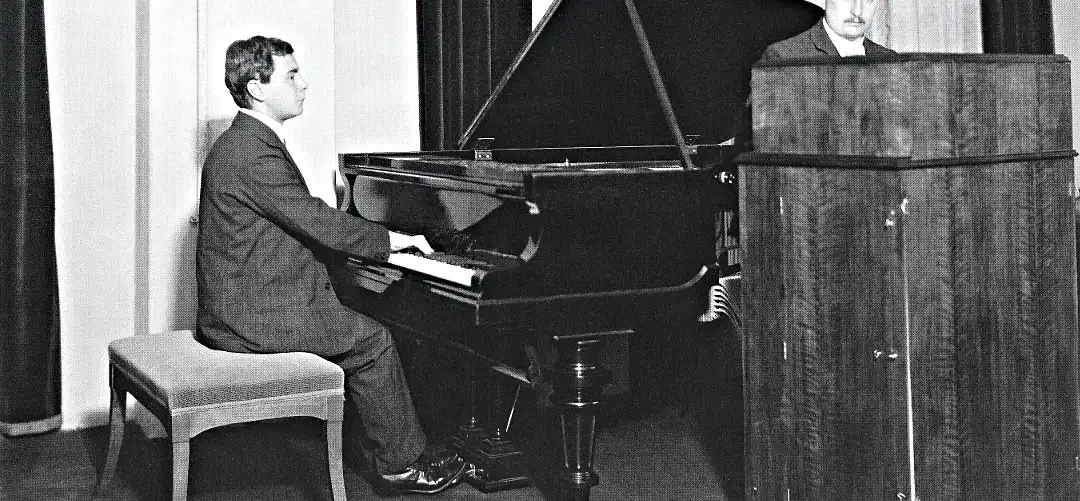
Unfortunately, no recording grand pianos survived the wars – and for reasons of secrecy, no design or patent documents were published either, so that to this day it is not entirely clear how exactly the recording process worked. The manufacturers’ descriptions in product catalogs and advertisements are very rough – every key of the recording grand was said to be electrically connected to the recording device and to have recorded the timing and length of the keys struck, usually as lines on a paper drum by means of rotating discs. Dynamics and pedal were said to have been recorded by an additional device that registered the speed and strength of the key strokes.
Only for Ampico and Duo-Art are more detailed descriptions available. For Welte and Hupfeld, well-established theories have emerged among experts about the probable way the music rolls were made. It is considered certain that from as early as 1904 not only the keys played, the tempo and the use of the pedal were recorded, but also the dynamics. In addition, trained staff probably noted down information on the musical performance or recorded it separately, and this was later worked into the so-called master roll.
The search for details of the recording technology has received more attention again in recent years, above all from the perspective of performance research. The Museum für Musikautomaten in Seewen is working on this topic in cooperation with various universities. The probably only surviving Welte recording apparatus, for organ recordings, can be seen in this museum. Details of Hupfeld’s recording technology were written down by Ludwig Riemann. As a musicologist, he wrote interesting publications on the nature of piano sound and the (musical) value of piano-playing devices. By his own account, he was present when Edvard Grieg played at the recording grand in Hupfeld’s recording salon. He described some of his findings in his publications.
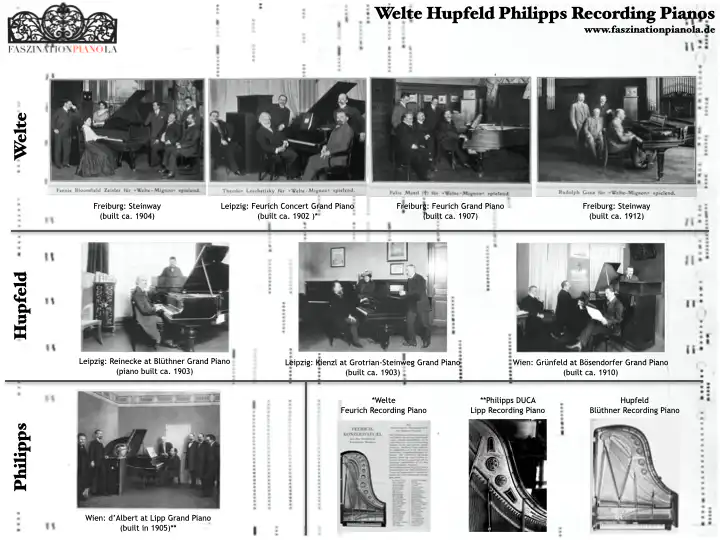
H.-W. Schmitz was able to track down the Lipp recording grand piano (serial number 26087), which was used at Philipps for the artist recordings. Unfortunately, the recording technology had been removed decades before. What had survived, however, were the many signatures of the pianists who made recordings for DUCA. The signatures on the cast-iron frame were evidently common practice and can also be found at Hupfeld and Welte. Factory photos of a Blüthner recording grand at Hupfeld survive. Welte’s very first recording grand is said to have been a Feurich concert grand.
Photos from the recording sessions at Hupfeld, Welte and Philipps show that Welte used grand pianos by Steinway & Sons and Feurich. At Hupfeld – presumably because Steinway and Feurich were already contractually bound to Welte – grand pianos by Blüthner and Grotrian-Steinweg were used, as well as a Bösendorfer grand at Hupfeld in Vienna. Philipps in Frankfurt used an R. Lipp grand piano.
In the search for details, above all of Welte’s recording process, Feurich as piano maker and Hugo Popper as a participant probably play a major role. Many questions remain to be answered here.