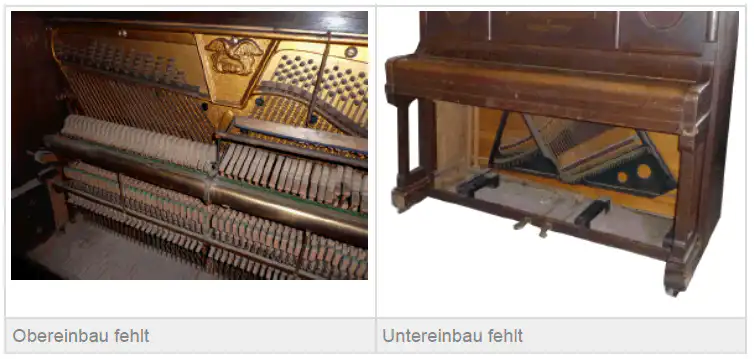

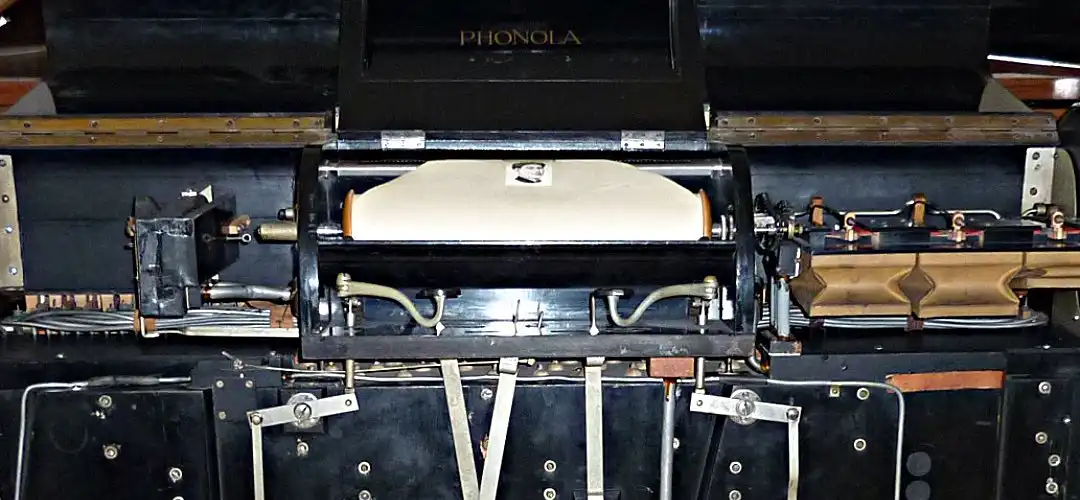
To familiarize you a little with the construction of the instrument, here is a short description of the essential elements. A more detailed description of the individual elements can be found in the other sections on this website.
In addition to the elements of a piano, a pianola, roughly speaking, has two further components depending on their arrangement: the upper unit (elements above the keyboard) and the lower unit (elements below the keyboard). The range of functions differs between pianolas, and so does the construction in detail. For an initial overview, here is a brief outline of how a pianola is constructed:
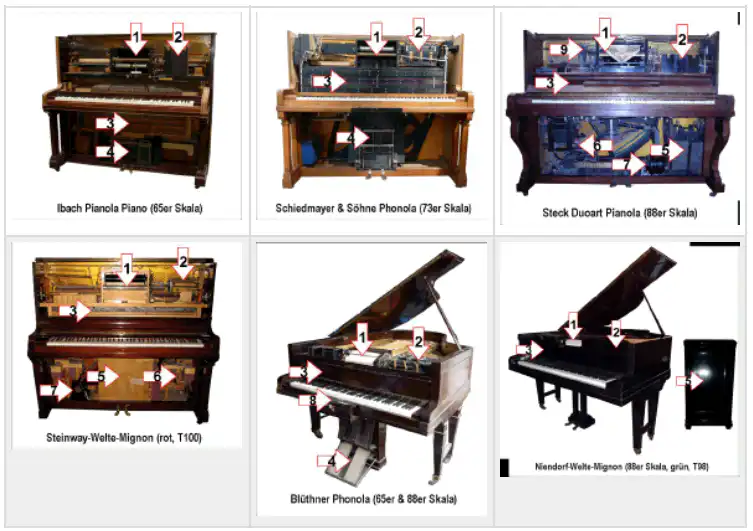
1 Tracker bar (scale)
2 Wind motor
3 Wind chest (contains the pneumatics)
4 Pedal system (for generating suction in foot-pumped instruments)
5 Pump unit (for generating suction in reproducing instruments)
6 Accent and dynamics control (in reproducing instruments)
7 Electric motor
8 Control levers for tempo, accentuation, dynamics
9 Tracking control (correct running of the music roll)
Instruments in which the pianola components are partly or completely missing keep turning up. After the heyday of the pianola, many instruments were destroyed or stripped because of malfunctions so they could be used as normal hand-played pianos.
So the first step should be to check whether the complete player mechanism is actually still present. Often only the upper unit was quickly removed – or only the lower unit. Since it is almost impossible to find replacements and having parts remade is very expensive, buying such pianolas is not advisable.