




Even though music rolls up to more than 100 years old are often still well preserved, many rolls have minor or major defects simply from repeated use. Minor defects can be repaired with reasonable effort. The take-up hook is often torn off. For this there are repair kits consisting of a new hook and an adhesive triangle for the start of the roll. If the music roll is torn, it can be mended with a special repair tape from book restoration (e.g. filmoplast P by Neschen). Never use commercially available adhesive tape, as it attacks the paper, is not flexible enough and shrinks over time, damaging the roll irreparably. A music roll that has been repaired should, however, be handled with care, since further defects usually occur during playing.
At Stanford University (USA), damaged music rolls are carefully repaired for digitization. Here is a report.
If the music roll shows severe deformation or tears at the edges, it can no longer be used sensibly, since the tracking cannot work properly and the roll keeps drifting. This cannot be repaired well either. The same applies if there are larger tears or deformations along the perforations. In such cases, it is advisable to have the roll scanned and recut. Even badly damaged music rolls can be scanned and preserved with the appropriate effort. If a roll flange is missing, it can also be replaced for most types – QRS offers a repair kit for its 88-note rolls (QRS Cat #46002).
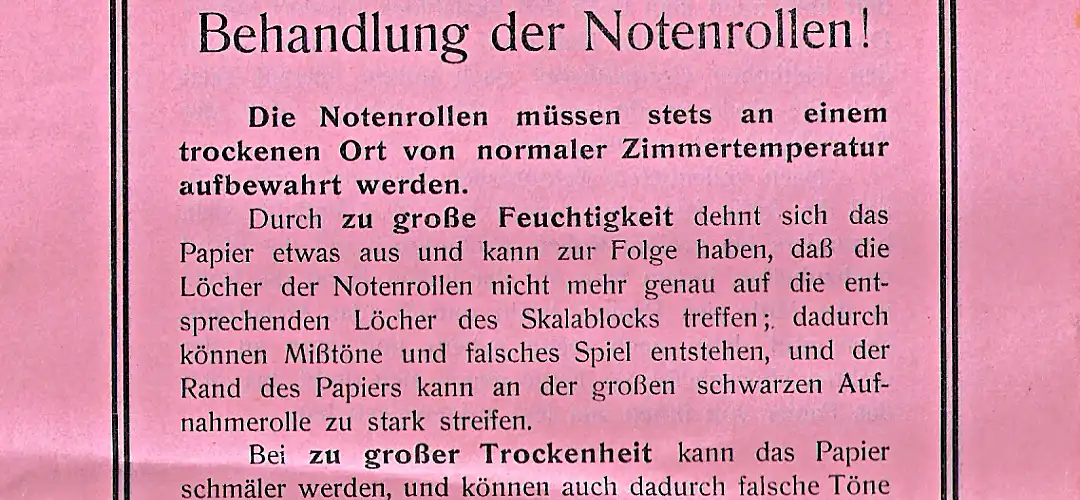
Particularly robust and durable papers were used for music rolls back then. Over the decades, this paper has also aged, has occasionally been stored too damp and has usually dried out considerably overall. This results in shrinkage and distortion that prevent error-free or faithful playback. The roll repeatedly drifts off track and the piece sounds wavering. In such cases, it is again advisable to have a copy made, since errors and inaccuracies can also be corrected in the course of scanning.
Then as now, proper roll storage and handling avoid the need for repairs. Even with the best storage, a roll will no longer be perfectly usable after 100 years. For regular use, high-quality new recuts are therefore recommended.