




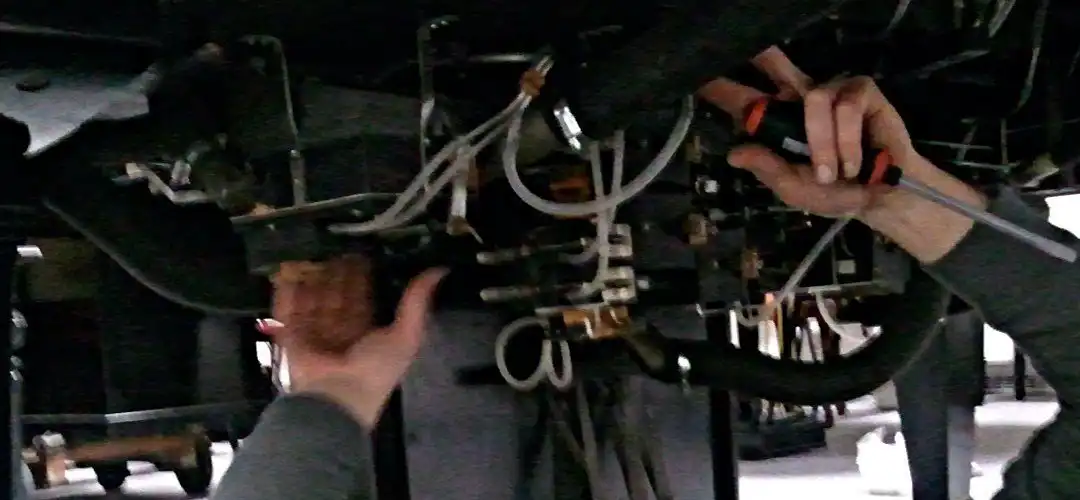
Does every pianola need to be renovated at all? Yes, because pianolas were only built until around 1940, and even in the best condition, after more than eight decades the materials are no longer airtight and supple due to aging, so that (almost) no pianola in original condition can give pleasure at a high level. Most unrenovated pianolas no longer produce a sound at all – and if they do, not sufficiently.
True to the approach that anyone can do anything if it can be learned – and the passion is there – it is possible to renovate a pianola. Then again, who has the time to invest several weeks and go through all the learning curves themselves, only to possibly not achieve a good result on the first attempt? If tinkering and puzzling things out is the motivation, a simple pianola can be a good starter project and adventure. Here, too, we recommend taking a few hours of lessons from a professional.
We strongly advise against attempting to restore more complex systems such as reproducing pianos yourself. Which aspiring vintage car enthusiast would choose the most complex and rarest model, for which there is hardly any information or expertise left, as their first restoration project?
Anyone who wants to use the pianola rather than renovate it needs a restored instrument. Even with a perfectly maintained instrument, the aging of the materials (leather, rubberized cloth, rubber tubing, etc.) and air channels (pneumatics, connecting tubes, etc.) is so advanced that reliable operation is no longer possible.