




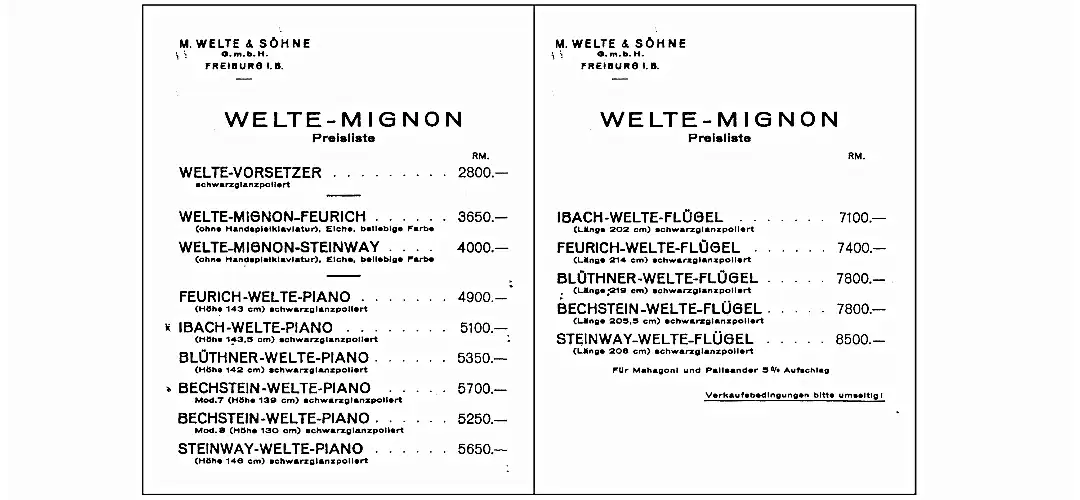
Only very well-off members of the growing upper middle class and of the rich and very rich upper class could afford to buy a pianola and additional music rolls. Considering that in 1910 more than 40% of the population still had an annual income of less than 900 marks and the vast majority of the remaining almost 60% an annual income of less than 3,000 marks – and that a modest living for a single person required about 1,500 marks – it quickly becomes clear, in view of the pianola prices below, that very few people could really afford such a system.
A pianola, and above all a reproducing piano, was a luxury good. And yet all manufacturers were able to profit so clearly from the prosperity of more and more households, which grew strongly with industrialization, that the manufacture of pianolas was one of the most important branches of industry between ~1908 and ~1920. The Welte-Mignon price list in the title image dates from 1928.
A Steinway Spirio – Steinway & Sons’ modern reproducing system – starts today at around 170,000.00 euros in a model B grand. Relative to today’s average annual income in Germany of around 60,000.00 euros, this corresponds to the price levels of the time. In other words, 2–3 annual salaries – which even today only the very wealthy can afford. A completely restored brand-name reproducing instrument by Welte, Hupfeld or Philipps costs around 50,000.00 euros today.
For orientation, here is some price information from original catalogs of the manufacturers of the time:
Price in 1904 of an Aeolian 65-note Pianola push-up player: ~1,250 marks
Price in 1904 of a Hupfeld Phonola push-up player: ~850 marks
Price in 1905 of a Hupfeld Phonola push-up player: ~950 marks
Price in 1908 of a Spaethe Pianist pianola upright: 1,850 marks
Price in 1910 of a Buff-Hedinger Feurich pianola upright: 2,100 marks
Price in 1910 of a Buff-Hedinger Feurich pianola grand: from 3,400 marks
Price in 1911 of a Welte-Mignon push-up player: ~2,100 marks
Price in 1911 of a Philipps DUCA/Pianella concert piano: 3,600 marks
Price in 1912 of a Hupfeld DEA Rönisch grand piano (2.15 m): 6,500 marks
Price in 1913 of a Hupfeld Phonola upright: 1,550 marks
Price in 1925 of a Hupfeld Triphonola Rönisch grand piano: 10,900 marks
Price in 1929 of a Hupfeld Triphonola Schiedmayer & Söhne grand piano: 5,950 marks
Another interesting detail from the Feurich sales books is the development of sale prices during the inflation. Here you can see the development up to September 24, 1923 for the best-selling Feurich Duca piano (“Eiche roh Mod III”, raw oak model III).
Date of sale / sale price in Reichsmarks
01Sep1915 / 746
22May1916 / 818
27Nov1916 / 895
24Jun1918 / 2,170
26Apr1920 / 2,400
07Jun1920 / 3,600
12Jan1921 / 7,100
27Jan1921 / 9,600
23Apr1921 / 15,110
31Dec1921 / 12,600
01May1922 / 42,000
05Jul1922 / 55,000
07Jul1922 / 49,500
31Aug1922 / 102,000
07Feb1923 / 4,995,000
26May1923 / 8,050,000
10Sep1923 / 22,313,367,925
24Sep1923 / 39,243,623,000