




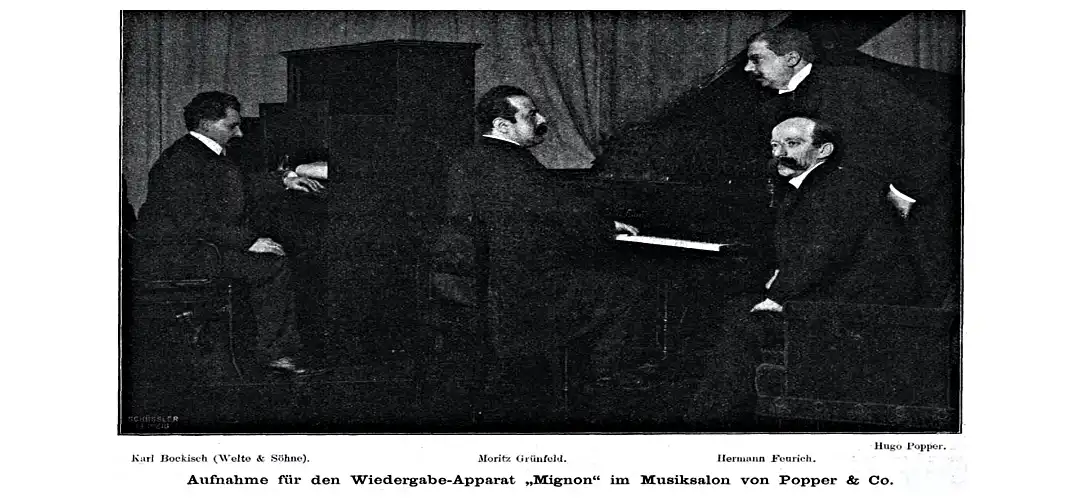
As so often with great developments, it was several brilliant people who made the Welte-Mignon such a worldwide success. Bockisch, Welte, Popper and Feurich (photo from the Zeitschrift für Instrumentenbau No. 25, March 1905) are, in our current assessment, the four personalities in the inner circle who, together with numerous participants and assistants, stand for this success.
To this day, it has not been possible to clarify exactly how the invention, the product maturity, the market launch, the marketing, the service, the worldwide economic success and the decline and end of the Welte-Mignon came about in connection with M. Welte & Söhne. Despite all initiatives, most of the story is still unclear.
Our aim is to help, through our activities, to bring committed experts together in the coming months and years so that the adventurous, brilliant, eventful and, above all, musically unique story can be understood and told more completely. We will also gradually publish and initiate more on the other German reproducing systems, such as the Philipps DUCA, Hupfeld DEA/Tri-Phonola and Popper Stella.
An article in the Zeitschrift für Instrumentenbau (September 1904) describes the first public presentation of the Popper “Artist” at the Easter preview fair in Leipzig. M. Welte & Söhne (Freiburg) is named as the originator. Undoubtedly the Mignon, still under the trademark “Artist” registered by Popper. Interestingly, Popper also registered the trademark “Mignon” on April 9, 1904. Popper also registered the trademark “Welte-Mignon” – on April 28, 1906. This may have been due to Popper’s exclusive distribution rights for the Welte-Mignon in Germany. Nevertheless, this is unusual from a manufacturer’s point of view.
The discussion about the naming alone will be a topic that needs to be examined more closely, since to our knowledge there were fierce disputes between Welte, Bockisch and Popper here. The name changes from “Artist” to “Mignon” to “Welte-Mignon” suggest that Welte ultimately prevailed – and, astonishingly, did not mention the presumed main inventor (Karl Bockisch) by name. The importance of Karl Bockisch is clearly emphasized in this article: “This piano orchestrion, like the ‘Artist’ expression apparatus, is the creation of Karl Bockisch, …, who as an innovator...”
Before the first presentation could take place, however, many months of preliminary work and certainly successful and failed attempts were needed to carry out the presentation at the Easter preview fair successfully. In addition to the technical implementation, one of the important preparations was the discussion about the market positioning and pricing model of the Welte-Mignon. Further research is needed here. An important clue can be found in a letter, to be examined more closely later, from Hugo Popper to his authorized officer Hermann Möhle (photo: Popper catalog) from 1906: “…my opinion has always been either to present the Mignon as a marvel and to ask 10,000.00 marks for it, or else as a standard article, and as such it is already very highly paid at 3,000.00 marks…” (source: copy of the letter, W. Baus, from the possession of Hanns Popper). At that time, the sale price of the Feurich Welte cabinet mentioned was 3,650.00 marks.
Hermann Feurich, a close friend of Hugo Popper and Ludwig Hupfeld, and at the same time the main supplier for Welte, Philipps and Popper reproducing instruments and an important supplier for Hupfeld, certainly also played a key role. The first recording grand for Welte recordings is said to have been a Feurich concert grand. Interestingly, twelve grand piano backs were delivered to Popper in 1903/04, but not one to Welte. Were recording instruments perhaps built in Leipzig at Popper or Feurich? Mr. Bockisch and Mr. Welte were most likely in Leipzig very often and for long periods in 1903–05.
So there are numerous oddities and gaps in the exploration of the history of Welte and the other manufacturers of reproducing instruments so far. These need to be deciphered together in the near future.