




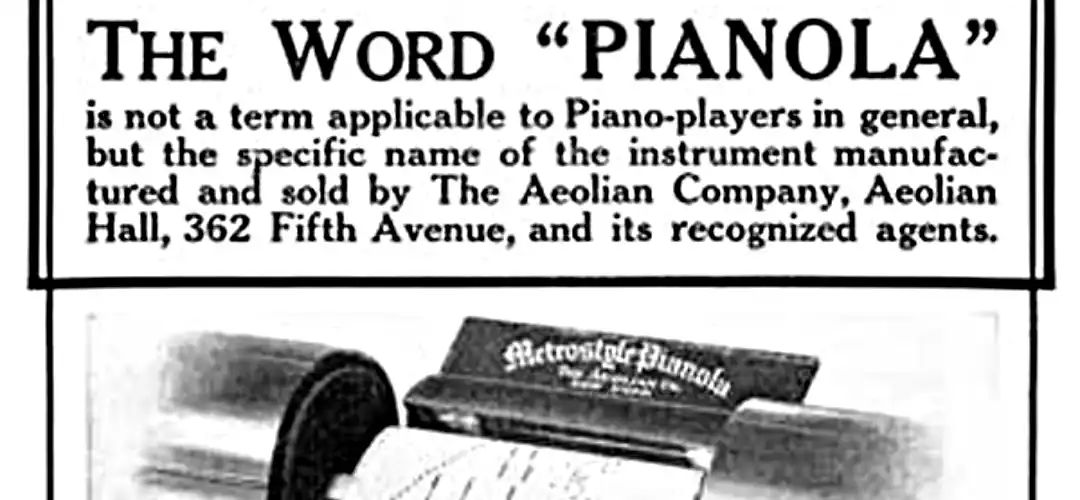
The name “Pianola” is actually a product name for the player mechanism built around 1895 by Edwin Votey, which was marketed very successfully worldwide from 1897 by the Aeolian Company of New York. This product name – even more than the name “Phonola” introduced by Hupfeld in 1902 – has survived to this day as the term for self-playing upright and grand pianos in general.
Many manufacturers then called their own instruments “Pianola grand” or “Pianola piano”, so the Aeolian Company repeatedly pointed out that the genuine Pianola came from its house. In German, the correct form is “die” Pianola and “die” Phonola (feminine), since the word ending was deliberately meant to be feminine.
Other manufacturers also registered their own word creations – often combined with the manufacturer’s name – as trademarks for their player instruments, such as Pleyela, Ibachiola, Orphobella, Phonobella, Pianella, Playola, Symphoniola, etc. – but none of them caught on like the term “Pianola” coined by Edwin Votey.
MECHANICAL PIANO
The term “mechanical piano” was already advertised by Hupfeld in 1893 in the Zeitschrift für Instrumentenbau. A pressboard roll was moved by a crank and, via a tracker, made the notes in the piano sound. The faster you turned the crank, the louder and faster the piece of music became. Although already impressive as a mechanical achievement, the sound remained very mechanical and hardly comparable to natural piano playing.
ELECTRIC PIANO
The term “electric piano” is also common in German-speaking countries – even though the vast majority of player pianos had no electric motor and were operated only with pedals. And these instruments are only truly “self-playing” if they are actually electrically driven pianos – otherwise it still takes the pianolist, who produces music from the music roll via the pedals and levers of the pianola.
Even though there were various player piano mechanisms much earlier in the 19th century, for example in France, Germany and the USA, it was certainly the American Aeolian Company that achieved the decisive breakthrough with the Pianola – and Hupfeld shortly afterward in Germany with the Phonola. Hupfeld made unparalleled use of the possibilities of advertising and the media of the time. Not only in the Zeitschrift für Instrumentenbau did Hupfeld advertise constantly and in the most prominent places for the Phonola – and quite deliberately against the Pianola.
The history of self-playing or so-called mechanical musical instruments goes back many centuries. Before player pianos, it was above all music boxes and musical clocks that brought mechanical music into mostly well-to-do homes. It was always the mix of inventiveness, fascination with technology and the joy of enjoying music that gave rise to so many different mechanical instruments.
In the late 19th and early 20th centuries – a time when there were not yet any satisfactory sound recordings or broadcasters for enjoying music at home, in cafés, bars or restaurants, a time when music was still a natural part of family culture – these player pianos had their heyday. The great success of the pianolas in the period from 1895 to 1935 – the highest annual sales were reached shortly before the First World War – was above all due to the fact that piano music had become the dominant form of music in households and that piano music belonged in every “good home” – even in those without any great talent for playing the piano. With the help of pianolas, piano music could be produced and enjoyed at a higher level there too. Since social life in countless cafés and dance halls was also flourishing at the same time, player pianos were fitted with additional instruments such as percussion, flutes, etc. and sold very successfully as orchestrions. True marvels of technology were created and became very widespread – much to the dismay of the many small orchestras.
The suppliers were very inventive in marketing these combined instruments. Since many households already owned normal hand-played upright and grand pianos, customers had to be persuaded to switch. To this end, trade-in schemes, free roll offers, subscriptions, etc. were offered. For piano dealers, the continuous sale of music rolls was a lucrative follow-up business. The latest titles were always advertised: current songs, marches, popular hits and new recordings of the most popular classical titles. An average pianola owner’s collection comprised about 50–70 titles. Not only the pianola manufacturers but also other companies concentrated on this interesting business. Music rolls were also available from libraries for a lending fee. People bought not only new titles, but also replacements for music rolls that had been played so often that they could no longer be used reliably.
TYPES OF PIANOLA ROLLS
Basically, there were two different pianola and roll philosophies – the arranged rolls, which recorded only the sequence of notes from the sheet music on the roll and left all accentuation and tempo control to the pianola player; and, in contrast, the reproducing rolls, which were recordings of a pianist’s playing and could be reproduced practically 1:1. An intermediate solution are the so-called artist rolls, which contained a pianist’s playing but left accentuation and tempo control to the pianola player.
As quickly as these pianolas rose, their era came to an equally rapid end. It took a long time for the gramophone record to reach a quality that allowed music to be enjoyed without disturbing noise, but then phonographs spread in large numbers into the well-to-do households that had previously preferred pianolas. In the mid-1920s, radio also spread very rapidly and displaced the pianolas even faster. Resourceful manufacturers tried to counter this by offering pianolas with built-in phonographs and/or radios – but these survival attempts were not successful. The pianola industry, which had recovered only poorly from the First World War and had been badly damaged by the economic crisis at the end of the 1920s, collapsed completely in the early 1930s. The L. Hupfeld AG – previously the world’s largest manufacturer of mechanical musical instruments, with more than 2,000 employees – had to cease production almost completely in 1934.
DIGITAL PIANOLA SYSTEMS
Today, digital computer-based player mechanisms are offered in upright and grand pianos – but these, too, are rather a rare niche today. Steinway Spirio and Yamaha’s Disklavier are examples. Thanks to worldwide networking, the data – what used to be the music roll – can now be downloaded and shared at will. Due to the restrictions of the coronavirus pandemic, the Freiburg University of Music held examinations using Yamaha Disklavier technology, transmitted from piano to piano over thousands of kilometers – here is the report on ZDF heute journal from June 13, 2020.
Like the attempt in the 1930s to combine pianola, gramophone and radio in one piano, today’s player instruments are true all-round entertainers. Our Galaxy Diamond Acrylic Concert Grand Piano from 2009 with a web-based PianoDisc system can be controlled via iPod/iPad and has a Bose sound system, a PianoDisc player, a lighting system, etc. This means you can now connect to live concerts anywhere in the world and watch the playing of, for example, Elton John, Norah Jones, etc. on a video screen – while the grand piano plays the pianist’s original performance, transmitted over the internet, live. Had Hupfeld, Welte and the others had these possibilities, they would certainly have made the same or more of them.
Many millions of player pianos and music rolls were produced in the period 1900–1930, of which only a few examples have survived the more than 100 years and the turmoil of history since then. Today it is mostly museums and passionate collectors who own these unusual player instruments. Happily, however, more and more people are once again becoming fascinated by the charm of these mechanical marvels, more than 100 years old, and making music with a pianola. And then as now, this music-making can spark great enthusiasm and joy in everyone involved.