



As in all specialist fields, the challenge is to find suitable offers in the first place. Only a few pianolas can be found on the private market. Buying privately as a layperson is a particular risk here and can only be recommended after prior advice or accompanied by experts.
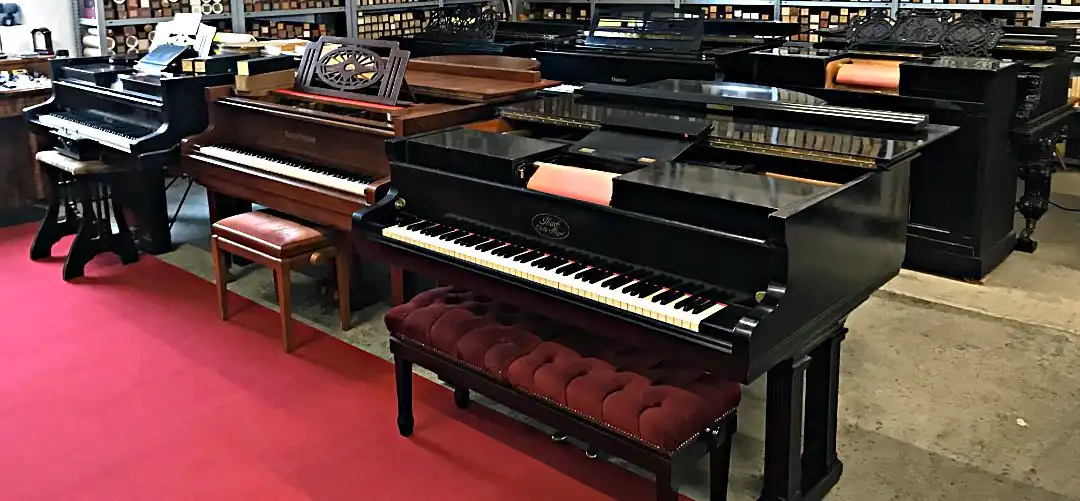
The best thing would be to compare different pianolas in the same place – because this makes it clearer what the differences actually are and what really matters. Since almost every pianola – except push-up players – contains a piano, knowledge of and a decision about the piano part and its interplay with the pianola part are also very important for later enjoyment.
The many questions here are considerably more complex than when deciding on a piano. With 65-note, 73-note or 88-note, or another music roll system? Which music rolls are available? With treadles or a suction motor? As a push-up player, cabinet or built-in instrument? A foot-pumped player piano, an expression piano, a reproducing piano? Which brand, which manufacturer – which combination? Old original or modern version?
In short – we recommend finding out as much as possible in advance and getting expert advice in order to make a good decision.
The reason for the complexity of choosing a pianola is that each system only offers certain functions and, so far, can only play the music rolls typical of that system, which in turn means that only the respective repertoire is available. And since it is always very much about the music, this discussion and decision is very important.
In addition, any renovation costs for the different systems are of a similar order of magnitude, so it is more important which pianola system is purchased.
These questions give an initial orientation.
-
- Was ist beim Pianola am wichtigsten? (Repertoire, Optik, Funktionen, Klang, technischer Zustand, Marke, Preis, Bedienung, Folgekosten, …)?
- Will the pianola be used mainly as a player piano or as a hand-played piano – and with what preferences?
- Which musical style is preferred? (Classical, particular composers, opera and operetta music, marches and dances, popular songs, ragtime, jazz and blues, pop music, …)?
- Do you want to listen to original recordings by the composers and pianists?
- Is an existing grand or upright piano to continue to be used, or used in parallel?
- Should the pianola only produce the notes, with all the accentuation and tempo control done by you?
- Should the pianola play fully automatically?
- Should it be an old pneumatic-mechanical instrument, with electronic-digital extensions, or a new system?
- What budget is available?
- Where will the pianola stand?
If the budget allows, the recommendation is of course clearly toward a reproducing piano such as the Welte-Mignon, Hupfeld DEA or Tri-Phonola, Philipps DUCA, AMPICO or Duo-Art built into a brand-name upright or grand piano. This combines the advantages of a high-quality hand-played instrument with the additional possibilities of the reproducing piano. The best of more than two worlds.

We support your search with the information on our website and will be happy to advise you on request.