




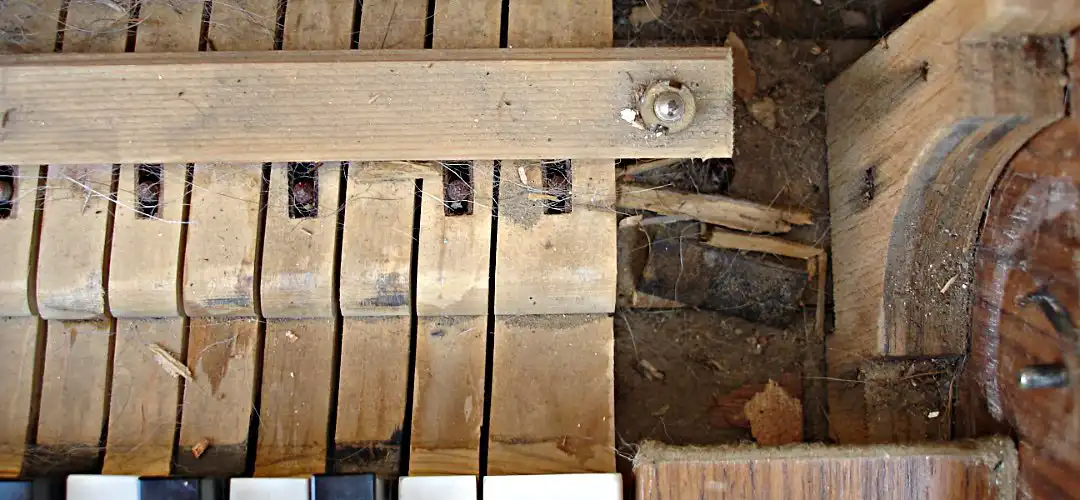
Best of all, keep the piano so clean that it needs little cleaning. Of course, this cannot be avoided entirely. Important for anyone buying a used piano: before it comes into the house, it should be thoroughly cleaned professionally, as over the decades it accumulates sometimes considerable and potentially harmful contamination inside (e.g. lead oxide, mercury in pianolas, mold, etc.).
A new or professionally cleaned piano only needs normal cleaning, like any other piece of furniture. So a feather duster and a lint-free cloth – no cleaning agents, no wet cloths. Polished surfaces stay beautiful for a long time if dust is removed carefully. If there are scratches or stubborn dirt, the surface can be repolished properly. However, this requires knowledge of the respective finish and polishing options. In particular, the natural shellac on old pianos must not be treated with cleaning agents, polishes or lacquers.
The interior of an upright or grand piano is very delicate. Please do not clean it yourself here, but call in a professional and either have it done or have it shown to you. Under no circumstances work with a vacuum cleaner or similar inside a piano on the delicate parts – and they are almost everywhere.
Over time, the soundboard of grand pianos collects dust. A soundboard cleaning rod set (available from us here), a special vacuum cleaner attachment and, if necessary, carefully applied compressed air (do not use in living spaces) can help here. But be careful – scratches on the soundboard or the frame happen quickly.
A dirty and discolored ivory keyboard can be professionally cleaned, bleached and polished so that it looks even and beautiful again. If it is not used for a long time, a piano should rather be kept closed to keep dust etc. away from the interior. The piano gets enough ventilation, as all lids are designed so that air can circulate even when they are closed.
Tempting as it is, never put glasses or vases with water in them on the upright or grand piano. The same applies to cups of hot drinks. The veneered wood surfaces are sensitive – especially the old shellac finishes. Condensation forms on the undersides due to temperature, causing rings. Hot cups dissolve the finish and leave rings. Scratches can be caused by any kind of object. Such surface damage can only be repaired with great effort. And if liquid does run into the instrument, potentially great damage results.