




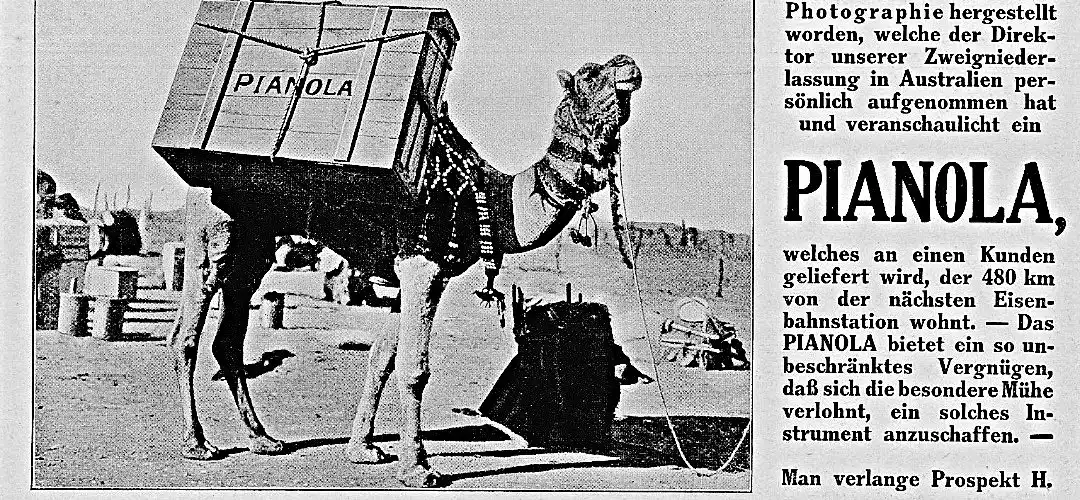
Because of its enormous weight of ~175–300 kg (385–660 lb) on average, a piano is usually considered one of the more “immovable” objects. Nevertheless, experience shows that a piano does need to be moved from time to time, both within the house and when moving home. Whenever possible, have this done by a specialist company or at least experienced movers – above all because serious injuries can very quickly occur with inexperienced people. Of course, the piano can also be damaged – or floors and walls.
A piano should be carried freely as little as possible; it is better to push it safely on a suitable dolly. A piano almost always has handles on the back for a better grip. Special straps are easier on the back. Two people can lift the piano so that a third can push a dolly underneath in the middle. Even on the dolly, the piano must always be held – and ideally also secured with a lashing strap. Children, and preferably adults too, should never be within falling distance of the piano. If in doubt, if the piano tips over, always “sacrifice” the piano rather than risk injury to people.
If you have to move the piano between floors, we always recommend a specialist mover – the risk of an accident is simply too great for laypeople. Without experience, special straps and enough people, it is very dangerous.
At this point, one of our favorite Laurel and Hardy clips with Stan Laurel and Oliver Hardy, “The Music Box”, in which a pianola is transported.
Hier klicken, um den Inhalt von YouTube anzuzeigen.
Learn more in YouTube’s privacy policy (opens in a new tab).
More details on the Oscar-winning short film “The Music Box” on Wikipedia.
If a piano has to be transported farther, you need, for example, a trailer or van/truck. Blankets are needed to protect the piano well from scratches and temperature fluctuations / moisture. The piano must be secured at least twice with suitable straps. Otherwise, in the event of unexpected braking or even accidents, these instruments become life-threatening projectiles.
The same considerations apply to transporting grand pianos as to upright pianos. However, it is generally advisable to have a grand piano transported only by a specialist mover, as handling is more difficult – and the weight, at approx. 250–500 kg (550–1,100 lb), is higher. You need special equipment such as a grand piano cover, a piano board, etc., a lot of experience and at least three people. The grand piano is then skillfully turned on its side (never tip a grand piano over the lyre) and moved on its side with the piano board on a dolly. On stairs, the grand piano should be carried (not pushed) to avoid damage.
Often a staircase or a house entrance that is too narrow does not allow it to be carried up – then the crane has to come. Sometimes a crane is also cheaper than attempting complex carrying operations.
Here is an example of a crane transport when picking up a Blüthner jubilee concert grand piano from the 4th floor in Amsterdam.
Hier klicken, um den Inhalt von YouTube anzuzeigen.
Learn more in YouTube’s privacy policy (opens in a new tab).