




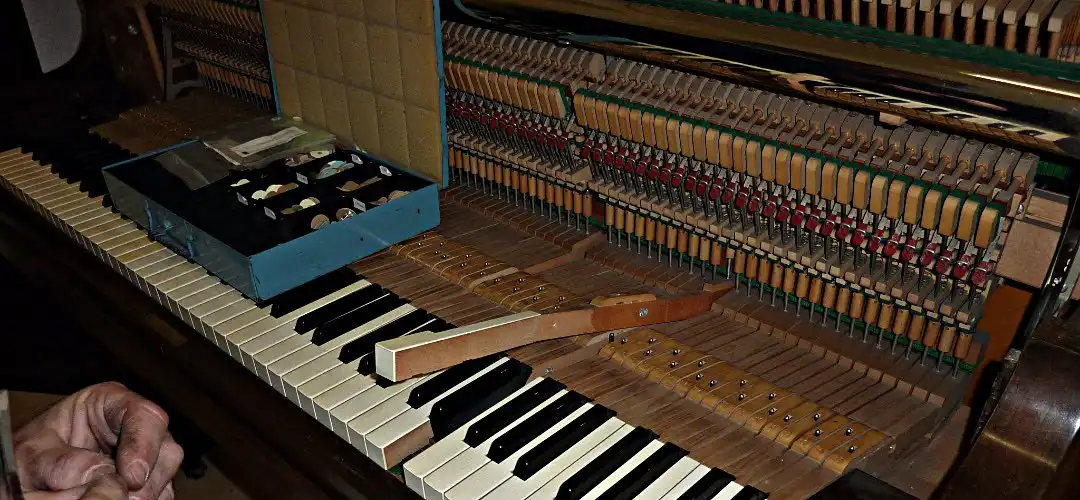
In the absence of a uniform definition, we describe our understanding here. What matters is to clarify in detail what exactly is to be done or has been done – no matter which term is used. In each specific case, we discuss this in detail, record the shared understanding in a quote and document the work carried out with photos.
Tuned?
Tuned means tuned. Normally nothing more. When and how, at what pitch, with what findings, how stable it holds, etc. is not stated by this alone. A tip: always ask the piano tuner to note a short report on the tuning and observations on the invoice.
Overhauled?
Overhauled means achieving as playable a result as possible with the existing substance, without carrying out major repairs. This does not necessarily remedy all shortcomings, and more overhauling might achieve an even better result.
Renovated?
Renovated, in the literal sense, means renewing, repairing, refurbishing. For an instrument, this means repairing and renewing everything that is necessary for perfect function. Not everything necessarily has to be renewed if parts are still so good that they would not be better after a renovation – or have no direct influence on the function. Whether this means only technical or also cosmetic overhauling must be clarified in each individual case. When overhauling the case, too, “only” everything necessary would be repaired and refurbished to achieve a result fit for the living room.
Restored?
Restored means bringing back the original condition the instrument had when it was originally delivered. In the extreme case, this would also mean reproducing any defects that may well have existed at delivery. Restoration – this term actually applies more in an art-historical context in collections and museums. Even with the best efforts, it is usually not possible to restore exactly the original condition, as most of the materials and tools of the time are no longer available today. Nor does it always make sense for function and appearance. For our fields of application, restoration therefore means restoring the original delivery condition as well as possible while achieving the best possible result.
For museums, restored rather means the debate between conservation and restoration. Theoretically, it is also possible to make a new instrument exactly on the model of the existing instrument, using only materials and tools of the time, in order to show it alongside the conserved instrument. Such examples can be found in some museums of historical instruments. Different requirements also apply here regarding material testing, scientific approach and documentation, as well as the preservation of the original parts removed or replaced.
If you own an instrument that needs an expert’s hand to become playable again – or to unfold its full splendor again – please read about our piano renovation service. We also offer appraisal of your instrument as a service. In cooperation with specialized masters of their craft, we can offer you the work you would like done on the instrument.