




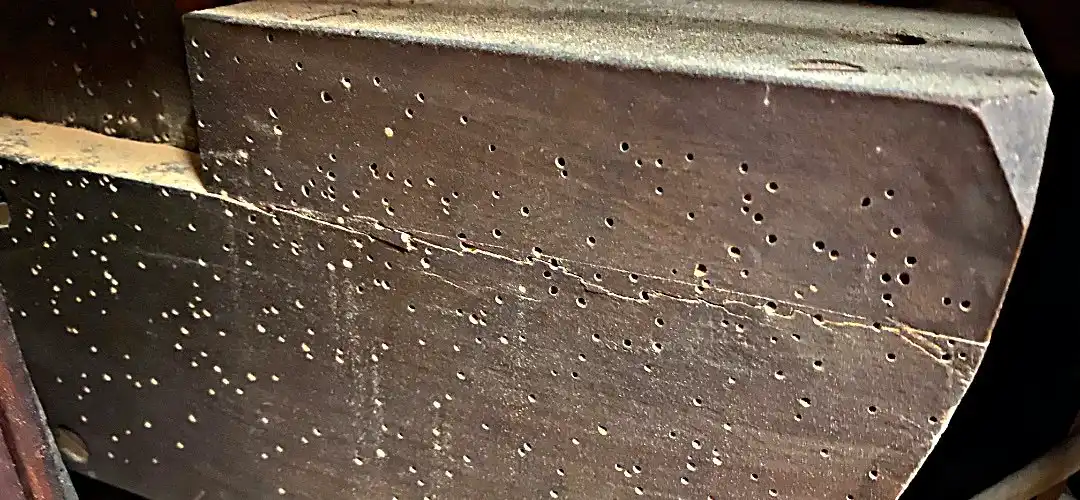
The woodworm, or more precisely the common furniture beetle and its larvae, love the soft woods in pianos. Traces of woodworm infestation can often be found on old pianos.
If traces of woodworm (bore dust) can be found anywhere, the woodworms have usually been busy in other, invisible places too. Whether the worm is still active cannot always be determined from old or fresh bore dust alone. In any case, such an instrument must be inspected professionally. Damaged wood must be replaced – and the instrument as a whole treated and protected against woodworm. This can be done locally by certified specialist companies – or, best of all, by fumigating the entire piano at a company certified for this.
We recently took two pianos suspected of woodworm infestation for fumigation to Binker GmbH in Lauf an der Pegnitz and conducted a short interview there on questions about piano fumigation.
Hier klicken, um den Inhalt von YouTube anzuzeigen.
Learn more in YouTube’s privacy policy (opens in a new tab).
If your piano is infested with woodworm, we recommend acting quickly. On request, we can also coordinate the transport and handle the fumigation at a specialist company.
If the woodworm infestation is considerable, especially in structural elements such as the back frame, a piano can sometimes no longer be restored at an economically justifiable cost. There is also a risk that the woodworm will attack other objects or building components in the room or house.
Please also read about our piano appraisal service.