




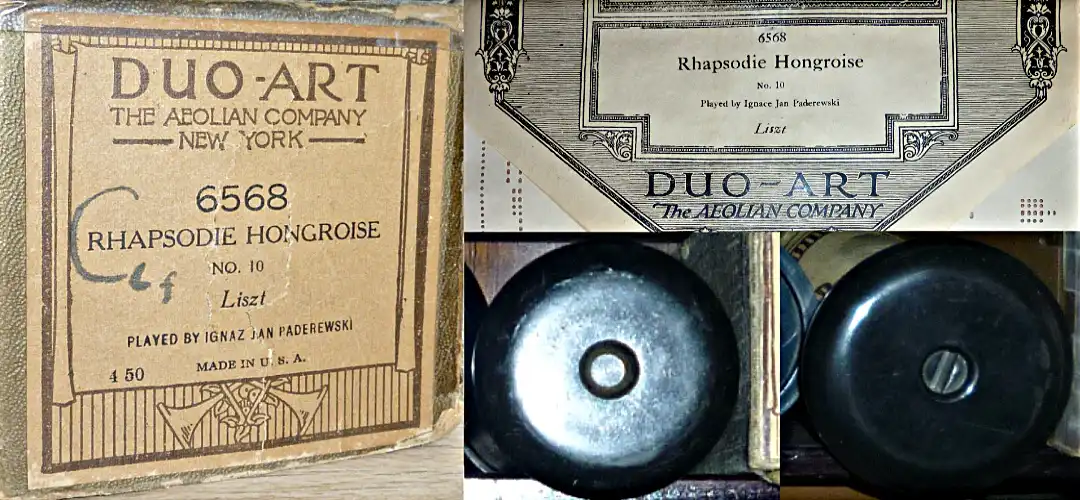
The Aeolian Company’s Duo-Art rolls are based on the 88-note standard format and additionally have the perforations needed for reproduction. Duo-Art music rolls can therefore also be played on normal 88-note standard pianolas – all you need to do is tape over four holes each in the bass and treble, since these are intended for expression control. At the start of the roll, Duo-Art rolls have the distinctive Duo-Art ornamentation on thicker paper, with the roll number, title and performer in the middle. Some rolls also carry the pianist’s photo a little above the start of the roll. In addition to this label, the boxes often also bear the pianist’s signature and usually a price for the roll. As with 88-note music rolls, the flanges are made of black Bakelite. There is a round eyelet at the start of the roll for hooking it into the take-up spool. Duo-Art rolls exist in large numbers in America and England as well-preserved originals. The paper is 28.6 cm (11¼ in) wide.
Aeolian’s Duo-Art plays 85 notes. The repertoire is particularly interesting because, in addition to the large classical repertoire, it is also strong in ragtime, blues, jazz, etc. Just as S. Rachmaninoff was a key driver of sales success for Ampico, I. Paderewski, with his many recordings, was for Aeolian Duo-Art. Other titles available only on Duo-Art, e.g. Gershwin’s Rhapsody in Blue as well as titles by Stravinsky and others, make Duo-Art very interesting. In the early 1930s, Aeolian also issued the Audiographic Series and the Educational Series, among others – music rolls with plenty of information about the composer, piece and pianist at the start of the roll. Wonderful.