




The Ampico reproducing system of the American Piano Company was – like the Aeolian Duo-Art – very successful above all in its home market, the USA, and in the UK, and is still rarely found in Europe today – although in the late phase European piano manufacturers such as Hopkinson, Grotrian-Steinweg and Bösendorfer also used this system.
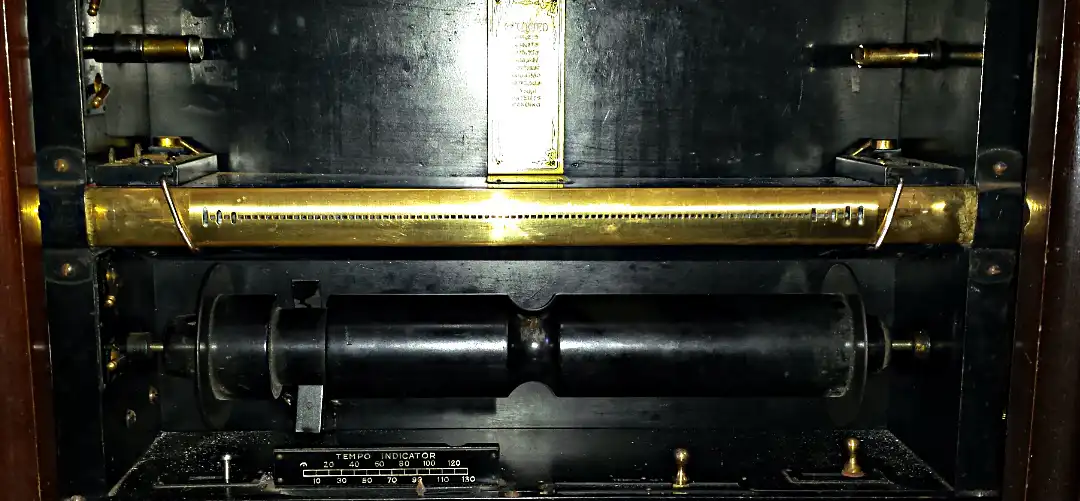
Striking is the arrangement of the tracker bar and the control elements as a drawer below the keyboard. This meant that the grand pianos were not artificially lengthened by the reproducing mechanism, as happened with Hupfeld, Welte and Duo-Art, where the upper mechanism had to fit between the pinblock and the keyboard. A 1.85 m Grotrian-Steinweg grand piano with the Ampico system is therefore a real 1.85 m grand – whereas, for example, a 1.80 m Niendorf-Welte grand contains only a 1.50 m grand piano.
Here is an excerpt from the Ampico A test roll, played on a Grotrian-Steinweg Ampico grand piano.
Hier klicken, um den Inhalt von YouTube anzuzeigen.
Learn more in YouTube’s privacy policy (opens in a new tab).
From 1913 there was the forerunner (Stoddard-Ampico) – from 1920 the mature Ampico A. Its further development – the Ampico B – was on the market from 1929. Compared with other reproducing systems, the Ampico system is interesting above all because of its special repertoire. The American Piano Company (formed from the merger of leading manufacturers/brands: Knabe, Chickering, Fischer, Haines, Marshall&Wendell and later Mason & Hamlin) succeeded in signing S. Rachmaninoff, who was very skeptical of reproducing instruments, exclusively for the Ampico system. This attracted a great deal of attention and drew both buyers for the Ampico and other well-known pianists. In addition to the rolls originally recorded by S. Rachmaninoff, there is the repertoire of so-called popular music, i.e. American music from the 1920s–1930s.
The scale of the Ampico A system has 100 holes in the tracker bar, including the two tracking levers for tracking control. The Ampico Inspectors Book of 1923 gives the following layout.
Even though the Ampico A was replaced in 1929 by the further improved Ampico B, it was mainly the Ampico A that was sold – and it is still in great demand today. Certainly one of the most beautiful reproducing systems!